Baby Play Ideas at Home: 25 Fun Activities for Babies
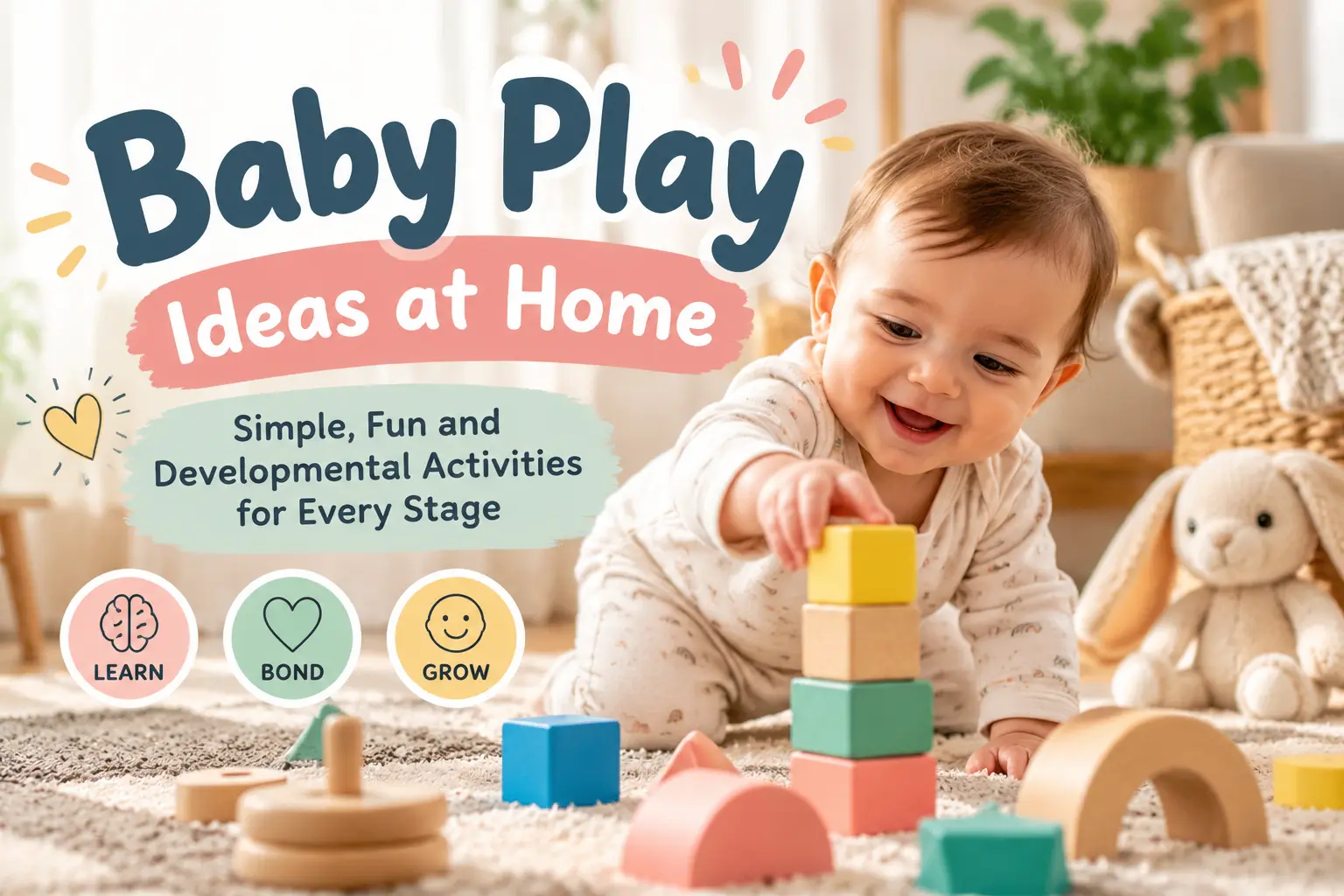
The best baby play ideas at home include tummy time, peekaboo, singing, sensory exploration, looking at board books, and reaching for safe toys. These simple activities help babies explore their surroundings, practise movement, and build communication skills without expensive equipment.
Parents can adapt activities for newborns, younger infants, and babies who are starting to sit or crawl. You can use everyday interactions, a clean floor, and a few age-appropriate toys to make playtime more engaging. The goal is not to keep your baby entertained every minute. It is to offer safe opportunities to explore, respond, and learn at their own pace.
Key takeaways
- Babies learn through movement, sounds, touch, sight, and interaction with familiar caregivers.
- Newborns benefit from gentle talking, singing, face-to-face interaction, and supervised tummy time.
- Babies aged 3–6 months can practise reaching, grasping, rolling, and visual tracking through simple games.
- Older babies benefit from supervised floor play, peekaboo, safe object exploration, and supported opportunities to practise new movements.
- Household objects are suitable only when they are clean, sturdy, age-appropriate, and free from choking or entanglement hazards.
- Short, responsive play sessions work well when parents follow their baby’s cues and allow breaks for feeding, rest, and comfort.
What are the best baby play ideas at home?
The baby play ideas at home for indoor activities combine interaction, movement, and sensory exploration. Start with a simple game, watch how your baby responds, and repeat it if they show interest. You do not need a packed schedule or a room full of toys.
The American Academy of Pediatrics explains that play supports learning from infancy, including early communication, physical movement, and exploration. Its guidance on the power of play provides useful background for parents choosing developmentally appropriate activities.
Here are five easy activities to try first.
1. Play face-to-face
Place your baby on their back on a safe, flat surface while you sit nearby. Smile, make gentle facial expressions, and pause to let your baby respond with a look, movement, or sound.
Young babies often enjoy familiar faces more than complicated toys. Keep your expressions gentle and give your baby time to look away when they need a break.
2. Sing nursery rhymes
Sing a familiar nursery rhyme or make up a simple song about bath time, feeding, or getting dressed. Use a gentle voice and repeat favourite lines.
Singing introduces rhythm, sound patterns, and opportunities for early language interaction. Your voice is enough; you do not need musical instruments or a speaker.
3. Try a gentle peekaboo game
Hide your face behind your hands for a moment, then reveal it with a smile. For younger babies, keep the game slow and simple. Older babies may enjoy watching you disappear behind a cloth and reappear.
Always keep the baby’s face uncovered and never place fabric over their nose or mouth.
4. Offer supervised floor play
Place your baby on a clean, firm play surface and position a suitable toy within comfortable reach. Let them look, kick, stretch, or attempt to reach for it.
Floor play gives babies room to move without being restricted by seats or other equipment. Stay close and remove objects that could injure your baby.
5. Look at a baby book together
Choose a sturdy board book with clear pictures and simple illustrations. Name the objects, point to the pictures, and use different voices to make the experience interesting.
Your baby does not need to understand the words. Hearing you speak and watching your face makes reading a useful shared activity.
Which activities for babies at home suit each age?
Baby play ideas at home depend on development, not justage. Newborns generally benefit from gentle interaction and supported positioning, while older babies may enjoy reaching, rolling, sitting, and exploring safe objects.
Babies develop at different rates. Use the following age groups as starting points rather than strict milestones, and adjust each activity to your baby’s comfort and abilities.
| Baby’s age | Activities to try | Main opportunity |
|---|---|---|
| 0–3 months | Face-to-face play, singing, gentle talking, supervised tummy time | Sensory awareness and early interaction |
| 3–6 months | Reaching for toys, mirror play, songs with movements, supported floor play | Head control, coordination, and exploration |
| 6–9 months | Peekaboo, rolling a soft ball, safe object exploration, crawling practice | Movement, problem-solving, and social play |
| 9–12 months | Hide-and-find games, container play with large safe objects, action songs | Hand coordination, imitation, and exploration |
Activities for newborns
Keep newborn play gentle and brief. Talk to your baby during everyday routines, let them look at your face, and provide supervised tummy time while they are awake.
Newborns need plenty of sleep and feeding opportunities. If your baby turns away, becomes unsettled, or appears tired, pause the activity.
Activities for babies aged 3–6 months
At this stage, many babies begin to show more interest in objects, sounds, and movement. Offer a lightweight baby toy, place it within reach, or move it slowly from one side to the other while your baby watches.
Use a baby mirror designed for infant use or sing a song with gentle hand movements. Always support your baby appropriately when they are not yet able to sit independently.
Activities for babies aged 6–12 months
Older babies may enjoy reaching across the floor, rolling a soft ball, playing peekaboo, and exploring how objects move. If your baby is crawling, create a safe area with enough room to move freely.
Do not force sitting, standing, crawling, or walking. Give your baby time to practise the movements they are ready to attempt.
How can I make tummy time more enjoyable?
Tummy time helps babies develop the muscles needed for head control and later movements. Place your awake baby on their tummy on a firm, safe surface and remain close enough to supervise continuously.
The American Academy of Pediatrics’ tummy time guidance recommends starting with short sessions and increasing the time gradually as the baby becomes stronger and more comfortable.
Try these three variations.
6. Tummy time with a favourite toy
Place an age-appropriate toy in front of your baby, close enough to see without forcing them to strain. Encourage them to lift their head or reach when they feel ready.
Move the toy slightly to one side to encourage looking in different directions. Keep the session comfortable and stop if your baby becomes distressed.
7. Tummy-to-tummy play
When you are fully awake, recline safely and place your baby on your chest while supporting them appropriately. Talk softly and make eye contact as they lift their head to look at you.
This can make tummy time feel more reassuring for babies who dislike lying on the floor. Never try this when you are sleepy or at risk of falling asleep.
8. Explore different safe surfaces
Place your baby on a clean play mat or another firm, stable surface suitable for supervised play. Let them experience the difference between the surface beneath their hands, arms, and body.
Avoid loose blankets that bunch up around the baby’s face. Keep pillows and soft bedding away from the play area, and move your baby to their back if they fall asleep.
How can I entertain a baby using everyday household items?
You can entertain a baby with simple household items when you choose objects that are safe for their age and supervise every interaction. A clean cloth for an adult to wave, a sturdy baby-safe mirror, or a board book can provide plenty of interest.
However, not every household item is suitable for infant play. Small objects, plastic bags, cords, breakable containers, and items with detachable parts can pose serious risks.
9. Play with a soft cloth
Hold a clean, lightweight cloth in your hand and move it slowly within your baby’s view. Let your baby watch the movement or reach toward it when developmentally ready.
Keep the cloth in your hand throughout the activity. Never drape it over your baby’s face or leave loose fabric within reach during unsupervised moments.
10. Make sounds with safe objects
Use your voice, gentle clapping, or a baby-safe rattle to introduce different sounds. Pause after each sound and watch whether your baby turns toward it or responds with movement.
Avoid loud, sudden noises near your baby’s ears. Do not use glass jars, sharp kitchen tools, or objects with loose pieces as improvised instruments.
11. Explore a baby-safe mirror
Position an unbreakable mirror designed for infant use where your baby can see it during supervised floor play. Talk about the face in the mirror and smile as your baby looks.
Babies may show different levels of interest depending on their age and development. Choose a securely made product without detachable pieces or sharp edges.
12. Turn a board book into a sensory game
Choose a sturdy book with contrasting pictures, familiar animals, or simple textures designed for babies. Point to one picture at a time and name what you see.
Keep books within your reach when your baby is still mouthing objects. Remove damaged books, loose decorations, and anything that could come away in small pieces.
Which sensory play ideas help babies explore the world?
Sensory play introduces babies to safe experiences involving sight, sound, touch, and movement. Start with one sensation at a time, use age-appropriate materials, and watch for signs that your baby has had enough.
Babies do not need elaborate sensory bins or messy activities. Everyday experiences, such as listening to a familiar voice or looking at a colourful toy, already offer opportunities to explore.
13. Explore contrasting colours
Show your baby a high-contrast picture card or an infant-safe toy with clear patterns. Hold it at a comfortable viewing distance and allow your baby to look without rushing.
Move the object slowly if your baby follows it with their eyes. Avoid flashing lights and direct bright light into the baby’s eyes.
14. Listen to different gentle sounds
Try singing, speaking softly, or using a suitable rattle. Change the sound gradually and leave a pause between each one so your baby has time to respond.
A quiet room can make it easier for your baby to focus. You do not need background television or several noisy toys playing at once.
15. Feel different safe textures
Offer a clean, securely made fabric toy or a textured baby book intended for the appropriate age. Let your baby touch the material while you remain close.
Inspect every item before use. Avoid materials that shed fibres, have loose decorations, or contain small pieces that could enter the baby’s mouth.
16. Try a gentle movement game
Hold your baby securely and sway slowly while singing a familiar song. Keep their head and body supported, especially if they are still developing head control.
Never shake, toss, or swing a baby forcefully. Stop if your baby appears uncomfortable, frightened, or overstimulated.
How can toys make baby playtime more engaging?
Age-appropriate toys can give babies safe opportunities to practise reaching, grasping, looking, and exploring. Choose toys based on your baby’s current abilities rather than buying a large collection of products.
Parents looking for suitable options can explore Luxe Baby Toys for baby toy ideas. Check each product’s recommended age, care instructions, materials, and safety information before introducing it into your baby’s routine.
17. Encourage reaching with a baby play gym
A suitable baby play gym can provide visual interest and opportunities for supervised reaching. Place your baby underneath it according to the manufacturer’s instructions, making sure the frame is stable and any hanging toys remain securely attached.
Keep cords and loose parts away from your baby. Stop using the gym if it becomes damaged or your baby can pull components free.
18. Explore a baby-safe rattle
Offer a lightweight rattle designed for your baby’s age. Demonstrate a gentle shake and pause to let your baby look, listen, or attempt to grasp it.
Inspect the toy regularly for cracks, loose components, or damaged seams. Choose a product that cannot fit dangerously into the baby’s mouth and follow all manufacturer warnings.
19. Practise grasping with suitable toys
Place one lightweight, easy-to-hold toy near your baby’s hand. Allow them to reach for it rather than repeatedly placing it in their palm.
As your baby develops more control, offer a different safe toy and observe how they explore it. Avoid toys with magnets, button batteries, sharp edges, or detachable small parts.
What are the best movement games for babies who are learning to sit or crawl?
Movement games should provide space for babies to practise skills they are developing naturally. Offer safe opportunities to reach, roll, pivot, sit with appropriate support, or crawl, without pushing your baby into a position they cannot manage independently.
Clear the floor before starting. Remove furniture with sharp edges from the immediate play area, secure unstable objects, and keep stairs inaccessible.
20. Roll a soft ball
Sit opposite your baby on the floor if they can sit safely, with support if needed. Roll a soft, suitably sized ball slowly toward them and let them explore it.
If your baby cannot sit independently, adapt the game to supervised floor play instead. Choose a ball that cannot fit into the mouth and never leave it with a baby unattended.
21. Encourage reaching from side to side
Place a suitable toy slightly to one side of your baby’s body while they are safely positioned on the floor. Give them time to look, turn, or reach toward it.
Repeat on the other side if they remain comfortable. Avoid pulling their arms or legs to make them move.
22. Play a simple hide-and-find game
For an older baby who enjoys object exploration, hide part of a familiar toy behind your back or a sturdy object. Ask, “Where did it go?” and reveal it after a short pause.
Keep the toy visible enough that the game stays engaging. Never hide objects inside bags, near the baby’s face, or in places that require unsafe reaching.
How can I keep a baby entertained without screens?
Parents can entertain babies without screens by talking, singing, reading, offering safe toys, and playing together on the floor. These activities let babies respond directly to real voices, faces, objects, and movement.
The NHS recommends interaction through books, songs, everyday objects, and shared play. Its baby and toddler play ideas offer additional suggestions for families.
23. Narrate everyday routines
Talk to your baby while changing a nappy, folding laundry, or preparing for a walk. Describe what you are doing in short, natural sentences.
For example, say, “Here is your clean shirt,” or, “Now we are opening the curtains.” Your baby does not need to understand each word to hear speech patterns and familiar sounds.
Keep the baby in a safe place while completing household tasks. Never leave a baby on a changing table, bed, sofa, or other raised surface unattended.
24. Play an action-song game
Sing a simple song and add gentle hand movements that suit your baby’s developmental stage. You can clap your own hands, wave, or move the baby’s hands gently when comfortable and appropriate.
Let your baby watch or respond in their own way. Avoid forcing movements or continuing when your baby turns away.
25. Create a mini reading routine
Choose a quiet moment and read one or two short books with your baby. Point to pictures, repeat familiar words, and let your baby pause to look.
You do not need to finish a whole book in one sitting. A few engaged minutes can be more useful than a longer session when your baby is tired.
How long should a baby play each day?
There is no single play-session length that suits every baby. Follow your baby’s feeding and sleeping needs, offer frequent opportunities for supervised movement and interaction while awake, and adjust the length of each activity to their comfort.
The NHS guide to keeping babies active recommends starting tummy time in short periods and increasing it gradually. Babies also need opportunities to move freely rather than spending long periods confined in seats or other equipment.
Try this flexible routine as a starting point:
- After waking: Talk, smile, or sing to your baby.
- During an alert period: Offer supervised floor play or tummy time when appropriate.
- Before a feed or nap: Choose a quiet book, gentle song, or calm interaction.
- Later in the day: Repeat a favourite activity or introduce one new toy.
- Whenever your baby needs a break: Stop and respond to their cues.
You do not need to complete every activity each day. Let your baby’s mood and development guide the routine.
How can I keep indoor baby activities safe?
Safe play starts with continuous supervision, an appropriate surface, and toys designed for the baby’s age. Check the environment before every session because babies can begin reaching, rolling, or moving unexpectedly.
Follow these precautions:
- Prevent choking: Keep coins, button batteries, magnets, small toy parts, and other small objects out of reach.
- Protect the airway: Keep plastic bags, loose cords, ribbons, and soft items away from the baby’s face.
- Supervise water play: Never leave a baby alone in a bath, basin, or container of water, even briefly.
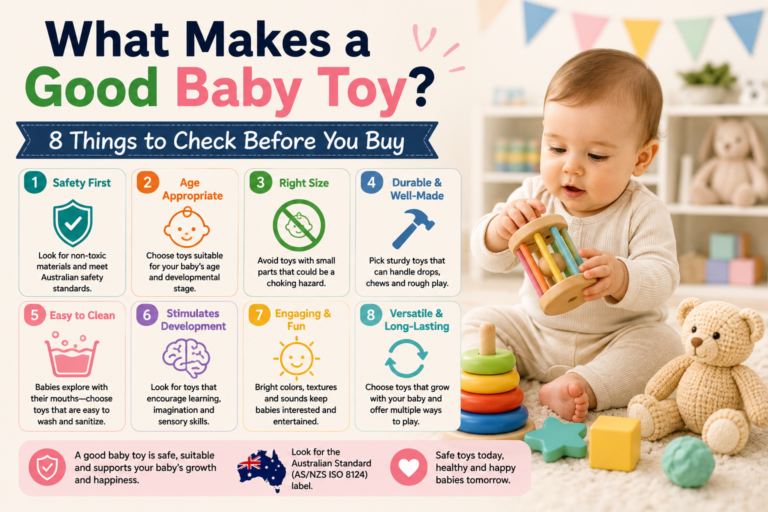
- Use suitable toys: Check age recommendations, warning labels, and product condition before every use.
- Choose safe surfaces: Use a firm, level play area away from stairs, heaters, unstable furniture, and sharp edges.
- Separate play and sleep: If your baby falls asleep during an activity, move them to an appropriate sleep space and place them on their back.
- Follow your baby’s cues: Stop when they appear tired, distressed, or uncomfortable.
For more information, read the CDC’s guidance on positive parenting for infants. Parents who have concerns about their baby’s movement, comfort, or development should discuss them with a qualified healthcare professional.
What should I do when my baby gets bored or fussy?
Change the activity or offer a break when your baby loses interest, turns away, fusses, or becomes unsettled. Babies may need food, sleep, a nappy change, comfort, or a quieter environment rather than another game.
Try these simple adjustments:
- If your baby looks away: Pause and reduce stimulation.
- If tummy time causes distress: Try a shorter session or a different supervised position recommended for your baby’s stage.
- If a toy no longer interests them: Change its position or switch to talking or singing.
- If your baby seems overstimulated: Turn off background noise and move to a calm space.
- If your baby is tired: End playtime and follow their usual sleep routine.
Repetition is normal. Babies often enjoy familiar games because they can observe the same action several times and respond differently as their skills develop.
Are expensive toys necessary for baby play at home?
No. Parents can create meaningful play opportunities with their voices, faces, books, safe floor space, and a small selection of suitable toys. The best choice is something that matches the baby’s abilities and allows safe exploration.
| Play option | Main benefit | What to consider |
|---|---|---|
| Face-to-face play | Social interaction | Requires no equipment |
| Board books | Language and visual exploration | Choose sturdy, age-appropriate books |
| Baby-safe rattle | Sound and grasping | Inspect for damage and loose parts |
| Baby play gym | Visual tracking and reaching | Check stability and attachment points |
| Soft ball | Reaching and movement | Choose a safe size and supervise |
| Sensory toy | Touch and exploration | Check materials, age guidance, and small parts |
You can build a small play collection gradually. Rather than buying a new toy for every activity, rotate a few safe options and use everyday interactions to keep play varied.
How can I plan a simple day of baby play at home?
A flexible routine helps parents offer different experiences without turning play into a demanding schedule. Combine communication, movement, sensory exploration, and quiet interaction across the day.
Use this sample plan as a guide, not a timetable that your baby must follow.
| Part of the day | Activity | How to adapt it |
|---|---|---|
| Morning | Face-to-face talking and singing | Keep it gentle for a sleepy baby |
| First alert period | Supervised tummy time or floor play | Choose a suitable position for your baby’s stage |
| Midday | Board book or sensory toy | Follow your baby’s interest |
| Afternoon | Reaching game or peekaboo | Keep sessions short if attention fades |
| Evening | Quiet singing and cuddles | Reduce stimulation before sleep |
The routine should fit around your baby’s needs. Feeding, naps, cuddles, and quiet time are just as important as structured play.
Final thoughts: Which baby play ideas at home should you try first?
The best baby play ideas at home are simple, safe, and responsive to your baby’s development. Start with face-to-face interaction, singing, tummy time when appropriate, books, and supervised floor play. Add new activities gradually as your baby becomes more interested in their surroundings.
You do not need to entertain your baby every minute or purchase a new toy for every stage. A familiar voice, a few safe objects, and time to move and explore can provide plenty of opportunities for learning.
If you are looking for age-appropriate toys to complement these activities, explore Luxe Baby Toys. Choose products carefully, follow their safety instructions, and remember that your attention is one of the most valuable parts of your baby’s playtime.