Best Toys for 1 Year Olds in Australia
Quick answer: One year olds are learning to walk, post objects into containers, and copy what adults do. The best toys for this age are shape sorters with two or three shapes, stacking rings, chunky knob puzzles, a stable push walker, and realistic pretend items like a toy phone or keys. Budget $25-$90 per toy in Australia, and choose fewer, larger things over many small ones.
Key takeaways
- If you buy one thing: a two- or three-shape sorter. It suits the exact skill a one year old is working on, costs under $30, and stays in use for a year.
- Start puzzles and sorters easy. The ten-shape version produces frustration, not learning. Difficulty should ramp.
- This is when imitation begins. A toy phone or set of keys will beat an expensive electronic learning toy, because copying you is the point.
- Check the volume before you buy anything with a speaker. Some toys measure above 85 dB at close range.
- Expensive first-birthday gifts are the most likely to be ignored. Play value has almost no correlation with price at this age.
Turning one is the first birthday where toys actually matter, and the first where people spend real money on them. It is also the age where the gap between what looks impressive in the shop and what gets played with at home is at its widest.
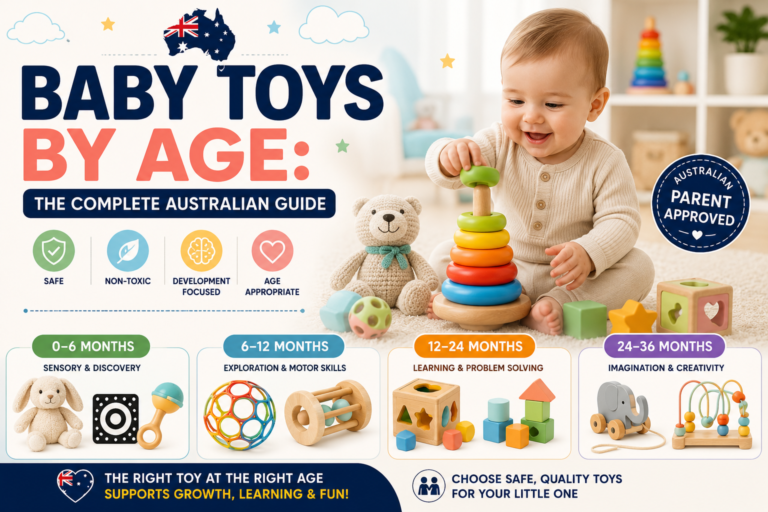
This guide covers what a one year old can actually do, the toys that match those skills, and the ones that reliably end up at the back of the cupboard. It sits inside our wider baby toys by age guide.
What a one year old can actually do
The twelve-to-twenty-four-month window covers an enormous amount of change, so it helps to split it.
At twelve months, most babies are cruising along furniture and some are taking first steps. They can pick up small objects with thumb and forefinger, deliberately let go, and are starting to understand that objects have purposes, a cup is for drinking from, not just banging.
Between twelve and eighteen months, walking becomes steady, and an obsessive interest in putting things into other things takes over. Posting, nesting, filling and emptying. This is the dominant play pattern of the stage and the reason shape sorters work so well here.
Between eighteen and twenty-four months, imitation takes over. Your toddler wants to sweep because you sweep, and hold a phone because you hold a phone. This is the beginning of symbolic play, and it does more for language development than any product marketed as a “learning toy”.
First words typically arrive somewhere in this window, though the range is very wide and late talking is common and usually unremarkable.
Best toys for 12-18 months
Shape sorters, start with two or three shapes
The best single purchase for this age. Posting is exactly what a toddler at this stage wants to do, and a sorter turns it into a solvable problem.
Critical: buy the simple one. A circle, a square and a triangle is plenty at twelve months. The ten-shape sorter that looks better value will be abandoned in frustration and picked up again at eighteen months, if at all.
AU price: $15-$40.
Stacking rings
Same logic as stacking cups, different skill, this is about ordering by size, which is a genuinely difficult concept. Expect your one year old to get the rings on in any order at first and sort them properly closer to two.
AU price: $12-$35.
Chunky knob puzzles
Four to six pieces, large wooden knobs, one picture per hole. The knob is the whole point: it forces a pincer grip and builds toward pencil control years later.
Skip jigsaw-style puzzles entirely for now.
AU price: $15-$30.
A stable push walker or walker wagon
If you did not buy one in the previous stage, now is the time. Look for a weighted or wide base so it does not shoot forward and cause a fall, and ideally adjustable wheel resistance.
Choose a push walker, where your toddler stands behind with feet on the floor, not a sit-in wheeled walker. Australian safety organisations including Kidsafe advise against the sit-in type because of fall and burn injury risk.
AU price: $50-$150.
Large building blocks
Wooden or soft foam, big enough not to be a choking risk. Stacking two blocks is a genuine twelve-month milestone; knocking down a tower you built remains more popular than building one for at least another year.
AU price: $25-$70.
Board books your toddler can handle themselves
Thick pages, flaps, textures. At this age the book gets carried around, chewed and used as a step stool as much as read, and that is fine.
AU price: $10-$20 each.
Best toys for 18-24 months
Realistic pretend items
Toy phone, set of keys, a small broom, a handbag, toy food. Unglamorous, cheap, and among the most-played-with things you will buy, because copying you is the entire point at this age.
AU price: $10-$40.
Ride-on toys
Feet-on-the-ground ride-ons first, where your toddler propels themselves by walking. Pedals require coordination most children do not have until around three, and balance bikes generally suit closer to two and a half.
Check the seat height against your child’s inside leg, both feet must sit flat on the ground.
AU price: $40-$130.
Simple musical instruments
Drum, shaker, xylophone. Your toddler makes the sound, which is the difference between an instrument and an electronic toy that plays music at them.
AU price: $20-$60.
Water and sand play
A water table, a bucket of scoops, a sandpit set. Given the Australian climate, outdoor water play is one of the highest-value categories for this age group and runs for most of the year in much of the country.
AU price: $20-$120.
First chunky crayons and mark making
Around eighteen months many toddlers start scribbling. Chunky, non-toxic, washable crayons and a large pad. Supervised, because they will still be mouthing things.
AU price: $10-$25.
The toys most likely to be ignored
Worth being honest about, because these are exactly the things bought as first birthday presents.
| Toy | Why it does not land |
| Large electronic “learning” tables | Passive. The toy performs; your toddler watches. Interest fades in days |
| Ten-shape sorters | Too hard. Frustration reads as disinterest |
| Complex jigsaw puzzles | Years early, knob puzzles only at this age |
| Enormous plush toys | No play function. They get cuddled once and stored |
| Dolls with tiny accessories | The accessories are choking hazards and get confiscated immediately |
| Anything requiring turn-taking or rules | Cooperative play does not develop until around three |
| Screens and tablet toys | Not developmentally useful at this age, and Australian guidance advises against screen time under two |
There is very little correlation between price and play value at this age. The two most-used items in most Australian households with a one year old are a $10 set of stacking cups and a cardboard box.
If you are the one being asked what to buy, our gift shortlist is in first birthday gift ideas: 25 toys that get played with.
Toy noise: the spec most parents forget
Electronic toys arrive in volume at the first birthday, and noise is the specification nobody checks in the shop.
Some toys measure above 85 dB at close range, and toddlers hold things close to their faces. Sustained exposure at that level is a genuine hearing concern, quite apart from what it does to the household.
Before you buy anything with a speaker:
- Check for a volume switch, not just an on/off. Two-level switches are common and worth insisting on
- Test it at arm’s length in the shop, then imagine it 20 cm from an ear
- Check whether the battery compartment is screw-secured, it should be
If a gift arrives without a volume control, a strip of tape over the speaker holes reduces output noticeably without damaging the toy.
Safety at one year
The risk profile shifts again once your toddler is mobile and climbing.
- The toilet roll test still applies. Anything that fits through the tube is a choking hazard until age three. Full method: choking hazards and the small parts test.
- Battery compartments must be screw-secured. Button batteries in particular can cause serious internal injury if swallowed.
- Anchor furniture and check ride-on stability. Climbing starts in this window, often before walking is steady.
- Check toy chest lids. Heavy hinged lids are a finger and neck hazard, look for soft-close hinges or ventilation gaps.
- Inspect older toys monthly. Chewed plastic cracks, and glued parts loosen.
Full Australian standards breakdown and a printable checklist: baby toy safety in Australia.
What it costs in Australia
| Item | Budget | Mid-range |
| Shape sorter (2–3 shapes) | $15 | $40 |
| Stacking rings | $12 | $35 |
| Knob puzzle | $15 | $30 |
| Push walker wagon | $50 | $150 |
| Large blocks | $25 | $70 |
| Pretend phone / keys / food | $10 | $40 |
| Total | $127 | $365 |
Kmart, Big W and Target all cover the budget column comfortably. The step up to mid-range buys better timber, safer finishes and longer life, worth it for blocks and puzzles, much less so for a toy phone that will be chewed and discarded within the year.
Prices are indicative for 2026 and vary by retailer and sale period.
What comes next
By around two, pretend play takes over completely and construction becomes more ambitious. The toys that suit that shift are covered in best toys for 2 year olds in Australia, and the full twelve-to-thirty-six-month range is mapped in best toddler toys in Australia.
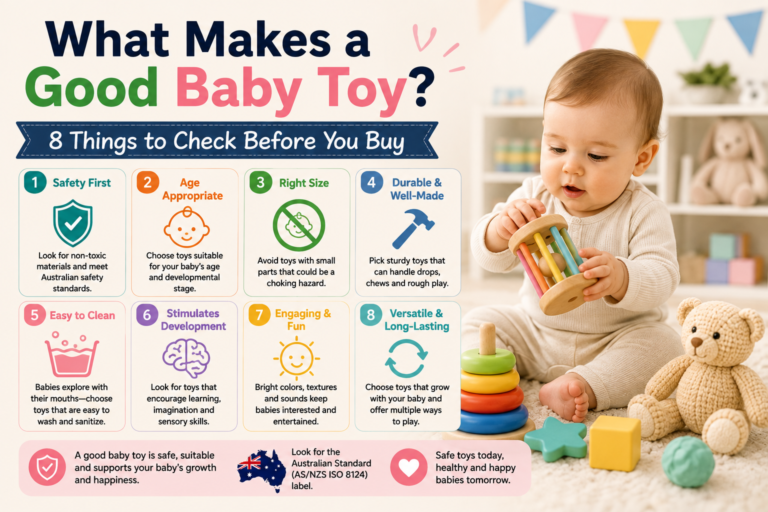
If you would rather judge toys yourself than follow age lists, the eight checks in what makes a good baby toy apply to every purchase from here on.
Frequently asked questions
What is the best toy for a 1 year old? A shape sorter with two or three shapes. It matches the posting-and-fitting skill a one year old is actively working on, costs under $30 in Australia, and stays in use for around a year.
How many toys should a 1 year old have? Six to eight accessible at a time, with the rest stored and rotated every two to three weeks. Fewer toys in view produces longer and more focused play, a well-documented effect in toddler play research.
What should I buy a 1 year old for their birthday? Fewer, larger, longer-lasting things. A push walker, a good block set or a ride-on will be used for years. Small electronic gadgets and large plush toys generally will not.
Are wooden toys better for 1 year olds? Well-made wooden toys last longer and have nothing electronic to fail, which matters for blocks and puzzles. For pretend items that will be mouthed and dropped constantly, plastic is cheaper and easier to clean. Finish quality matters more than material.
When can a toddler use a shape sorter? Most manage a two- or three-shape sorter from around twelve months, and progress to more shapes closer to eighteen. Starting with ten shapes usually causes frustration rather than learning.
Is it safe to give a 1 year old a ride-on toy? Yes, provided both feet sit flat on the ground when seated and the toy is stable. Feet-on-the-ground ride-ons suit this age; pedal versions require coordination most children do not have until around three.
How we choose the toys we recommend
Every recommendation is assessed against Australian safety standards, developmental fit for the stated age, durability under real use, washability, and value at current Australian retail prices. We prioritise products actually available to buy in Australia. Affiliate links, where used, are disclosed at the top of the article and do not affect ranking.