Are Electronic Toys Bad for Babies? An Evidence-Based Guide for Australian Parents
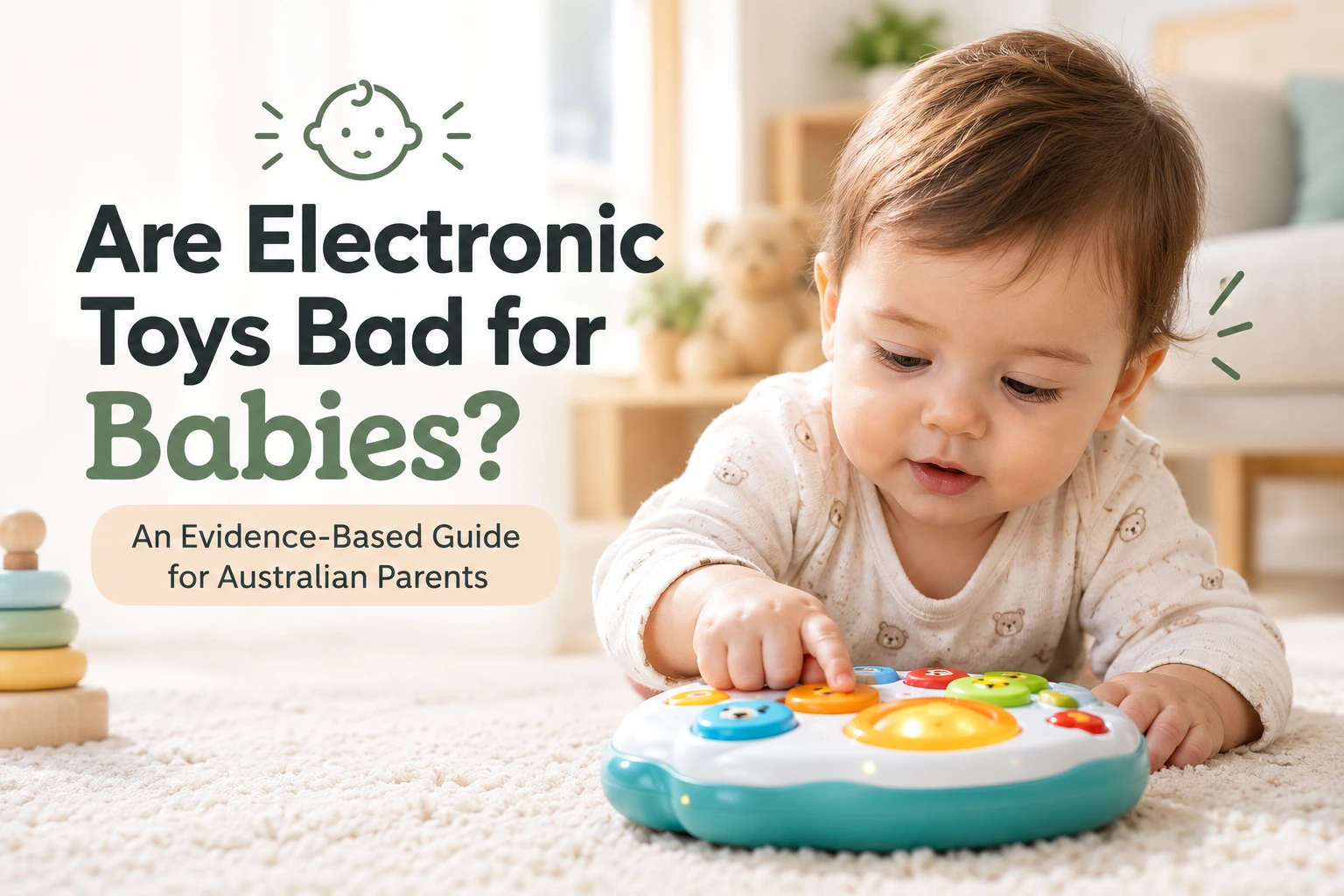
Are electronic toys bad for babies? Not by themselves, but they can cut down the talking between you and your baby. A 2016 JAMA Pediatrics study found that parents spoke less during play with electronic toys than with books or simple toys. So the real test is not the battery. It is whether the toy takes over the conversation. This guide helps Australian parents, grandparents and gift buyers judge any toy with four quick checks covering language, hearing and battery safety.
Key takeaways
- Parents in a study of 26 parent-infant pairs (babies aged 10 to 16 months) averaged about 40 words per minute with electronic toys, 56 with traditional toys and 67 with books.
- Sound-and-light toys do not harm babies on their own, and the lead researcher advises parents to treat them as entertainment, not teaching tools.
- Australian guidelines recommend no sedentary screen time for children under two, so any toy with a display counts against that limit.
- Toy sounds near 85 decibels can put hearing at risk, and babies often hold toys against their ears.
- Australian law has required secure battery compartments on toys with button batteries since 22 June 2022.
- As a rule of thumb (not a research finding), keep electronic toys to one or two of the five to ten toys within your baby’s reach.
Are Electronic Toys Bad for Babies?
An electronic toy is a battery-powered toy that plays sounds, music, lights or spoken phrases when a baby presses a button or moves it. Electronic toys are not harmful in themselves. However, they often reduce the parent talk that drives early language. Anna Sosa, the lead researcher on the main study, said parents can give babies these toys but should treat them as entertainment. She also noted that an “educational” label does not mean the toy teaches a baby anything yet.
The problem is the hand-off. A toy that sings the alphabet leaves the parent with little to add. Stacking cups, in contrast, invite you to name colours, count and react.
What Does the Research Say About Electronic Toys and Language?
Research shows that electronic toys lower the amount and quality of parent talk during play. Sosa and colleagues published the key study in JAMA Pediatrics in 2016. Twenty-six parent-infant pairs, with babies aged 10 to 16 months, played at home in 15-minute sessions. Each pair used three sets: electronic toys (a baby laptop, a talking farm and a baby phone), traditional toys (a wooden puzzle, a shape sorter and rubber blocks) and board books.
Parents averaged about 40 words per minute with electronic toys. With traditional toys, they averaged 56. With books, they averaged 67. According to The ASHA Leader, conversational turns and parent responses also dropped during electronic play.
Several limits apply. The sample was small, the sessions were short, and the study did not track later language outcomes. Therefore, treat the findings as a strong signal, not proof of long-term harm.
Do electronic toys affect children with autism or language delay?
A later JAMA Pediatrics study found the same pattern in children with and without autism. Parents produced fewer utterances per minute with electronic toys (16.25) than with traditional toys (18.65) in 10-minute sessions. The authors concluded that electronic toys are not necessary for language support. Still, speak with your child’s speech pathologist before you change a toy routine.
How Do Electronic and Traditional Toys Compare?
Traditional toys let the baby lead and give the parent more to say, while electronic toys lead the play themselves. The table compares both types across six features.
| Feature | Electronic toys | Traditional toys |
| Who leads play | The toy’s pre-recorded responses | The baby and the parent |
| Parent talk (Sosa, 2016) | About 40 words per minute | About 56 words per minute |
| Ways to use | Usually one or two, set by the buttons | Many: stack, bang, hide, pretend |
| Hearing risk | Possible if the volume is high or the speaker meets the ear | Low, apart from squeaky or noisy items |
| Battery risk | Button batteries need a secure compartment | None |
| Best use | Short, supervised play with a volume control | Daily play at any age |
Traditional does not mean wooden only. Sosa’s traditional set included rubber blocks, so the difference lies in interaction, not material. For age-specific picks, see our baby toys by age guide.
Are VTech Toys Good for Babies?
VTech toys are acceptable for babies in moderation, especially models with a volume switch, if you play along instead of letting the toy talk. VTech Baby is the company’s infant range. User manuals for the Lil’ Critters Moosical Beads, Sing & See Magic Mirror and Shake & Wobble Busy Ball each list an on/off/volume switch with low and high settings. The Moosical Beads manual also describes an automatic shut-off.
Pros
- Many infant models include a volume switch.
- Automatic shut-off limits long sessions on some models.
- Beads, mirrors and busy balls give babies something to grasp and move.
Cons
- Pre-recorded songs and phrases can replace your voice.
- Learning claims on the box lack support in the Sosa study.
- Button or coin batteries may sit inside, so you must check the compartment.
The Sosa study did not test VTech models. Its results apply to the toy type, not the brand. Choose the low volume setting, and put the toy away after a few minutes. [NEEDS EXPERIENCE INPUT: add the VTech model you tested, the AUD price you paid and what you observed.]
Can Electronic Toys Damage a Baby’s Hearing?
Loud electronic toys can put hearing at risk when sound nears 85 decibels or when a baby holds the speaker to the ear. The American Speech-Language-Hearing Association (ASHA) reports that toy sirens and squeaky toys can reach 85 dB, about as loud as a lawn mower. It adds that a 90 dB toy held next to the ear can sound as loud as 120 dB.
Babies mouth, shake and press everything, so a safe distance is rare. Therefore, test any toy yourself. Hold it where your baby would, press every button and listen. If it sounds too loud to you, it is too loud for your baby. A free sound-level phone app can confirm the number.
Also keep loud toys out of the car, where noise bounces off the windows. Our guide to toys for car trips with baby lists quieter options, such as soft books and lightweight rattles.
Are Battery-Operated Baby Toys Safe in Australia?
Battery-operated baby toys are safe when they meet Australia’s mandatory button and coin battery standards and when you check the compartment yourself. The standards became mandatory on 22 June 2022. They require secure compartments that stop children reaching the batteries. According to the Queensland Government, a compliant compartment needs a screwdriver, a child-resistant lock, or two independent movements to open.
The stakes are high. When the standards began, the ACCC said three Australian children had died and about one child a month suffered serious injury from button batteries. As a result, check every electronic toy at home. If a compartment opens easily, stop using the toy and keep it out of reach.
Be extra careful with cheap marketplace toys. Red Nose cites CHOICE testing in which 17 of 24 toys failed the mandatory standards. Report unsafe products to the ACCC through Product Safety Australia.
Do Electronic Toys Count as Screen Time?
Toys with a display count as screen time, while button-only toys fall outside the guideline’s screen definition. The Australian 24-Hour Movement Guidelines recommend no sedentary recreational screen time for children under two. For two-year-olds, the limit is one hour a day.
The guidelines also set movement targets that electronic toys cannot meet alone. Babies need at least 30 minutes of tummy time a day, and children aged one to two need at least 180 minutes of physical activity. Furthermore, babies should not sit restrained for more than one hour at a time.
Therefore, a toy that keeps a baby seated and pressing buttons competes with movement. Choose floor play first. Our baby play ideas at home guide offers 25 floor-based activities.
How Do You Choose a Safe Electronic Toy for a Baby?
Run four tests before you buy or keep any electronic toy: voice, volume, battery and baby-power. Each takes under a minute.
- Voice test. Press every button. If the toy answers with full phrases, expect less parent talk. Prefer toys that stay quiet until the baby acts.
- Volume test. Hold the toy at ear height and listen. Pick models with a volume switch, and keep it on low. Reject anything that startles you.
- Battery test. Open the compartment. It should need a screwdriver or a child-resistant lock. If it pops open, return it.
- Baby-power test. Ask what the baby’s body does. Rattling, grasping, rolling or pulling counts. Pressing one button repeatedly does not.
Then apply the shelf rule: keep one or two electronic toys among the five to ten on show. Our guide on how many toys a baby needs explains the small-collection approach.
Which Toys Suit Each Age, and Where Do Electronic Toys Fit?
Newborns need almost no electronic toys, because they use toys as tools with a parent. Our guide to the best toys for newborns lists four or five items, such as contrast cards, a soft rattle and a mirror. For awake-time ideas, read how to play with a newborn.
Between three and six months, babies grasp and mouth everything, so washable textured toys work best. See the toys for 3 to 6 month babies guide. From six to twelve months, cause-and-effect toys become useful. A ball drop or pop-up toy teaches the same idea without batteries, as the toys for 6 to 12 month babies guide shows.
At one year, babies copy adults, stack and post. Our best toys for 1 year olds and educational toys for one year olds guides focus on stacking cups, shape sorters and board books. Meanwhile, our first birthday gift ideas skip electronic toys for the same reason. For older children, see the best toddler toys in Australia.
When Does This Advice Not Apply?
This advice does not fit every child or every situation. First, the research covers babies aged about 10 to 16 months in short play sessions, so it says little about newborns. Second, some children use sound and light toys to calm down or focus. Our sensory toys guide explains how autistic and ADHD children often use them that way.
Third, sleep aids such as a projector nightlight work differently from play toys. In these cases, ask your child’s paediatrician or occupational therapist instead of removing toys by default. Finally, remember that the studies measured short sessions, not whole childhoods.
How Can You Play With an Electronic Toy So It Helps?
You can make electronic toys more useful by treating the buttons as a prop and doing the talking yourself. Try these habits:
- Switch the sound off for half of each session, and name what your baby does.
- Repeat your baby’s sounds before you press the button again.
- Narrate colours, animals and numbers in your own voice.
- Limit play to a few minutes, then move to a book or blocks.
- Rotate toys weekly so none becomes the default.
[NEEDS EXPERIENCE INPUT: add one routine you tested, how long you ran it and what changed.]
What Else Do Parents Ask About Electronic Toys?
Are electronic toys bad for newborns?
Newborns gain little from electronic toys. They see best at close range and respond to your voice and face. Use high-contrast cards and gentle singing instead. No study cited here tested newborns, so this is a practical recommendation, not a research result.
Do educational electronic toys make babies smarter?
The studies cited here show no such effect. Sosa said that an educational label does not mean a toy teaches babies anything yet. Books and conversation produced more parent talk than electronic toys in her study.
How many electronic toys should a baby have?
One or two is a sensible limit among five to ten toys. This is an editorial rule of thumb, not a research finding. Fewer toys within reach also make play calmer and easier to join.
Are musical toys bad for babies?
Music is not the issue. Volume and passivity are. When you sing, your baby gets music plus eye contact and a response. If you use a musical toy, choose the low setting and join in.
Are wooden toys better than plastic electronic toys?
Material matters less than interaction. Sosa’s traditional set included rubber blocks and a shape sorter, not only wood. Choose toys that make you talk, move and respond.
Should I throw out the electronic toys my baby already has?
No. Check the volume and the battery compartment, reduce use, and play along. Keep one or two favourites, and rotate the rest out of sight.
What Should You Do Next?
So, are electronic toys bad for babies? No, but they work best as a small part of a toy collection, not the centre of play. Run the four tests, keep the volume low and talk more than the toy does. Then check the battery compartment tonight. Finally, browse our Baby Toys by Age hub for simple, battery-free alternatives.