Best Toys for Babies 3–6 Months Old (Australian Guide)
Quick answer: Between three and six months babies develop voluntary reaching and grasping, and everything they grab goes into their mouth. The best toys for this stage are lightweight, easy to hold, and completely washable: textured grasping balls, silicone teethers, a play gym with detachable toys, wrist rattles and an unbreakable mirror. Budget $60–$150 in Australia for a complete set.
Key takeaways
- This is the stage where your baby starts actually playing: Grasping becomes deliberate around four months, and it changes everything.
- Everything goes in the mouth: That is not misbehaviour, the mouth is a baby’s most sensitive investigative tool at this age. Buy accordingly.
- Weight matters more than parents expect: A toy too heavy to lift with one hand gets abandoned.
- Washability is the single most important spec: If it cannot be machine washed or wiped down properly, do not buy it.
- Kmart and Big W silicone teethers are as safe as boutique versions: Provided they are one moulded piece with nothing glued on.
Somewhere around sixteen weeks, your baby will reach out, aim, and successfully grab something. It is a genuine milestone, and it changes what they want from a toy completely.
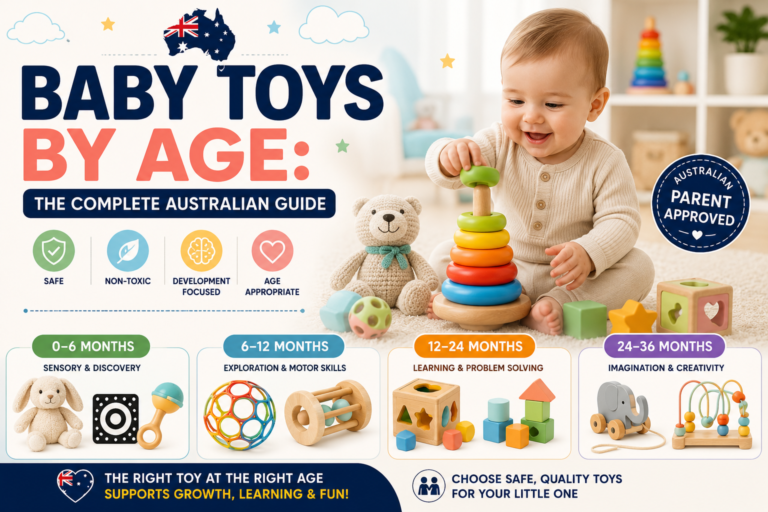
Up to this point, play was passive, looking and listening. Now it becomes physical. This guide covers the toys that suit that shift, what to skip, and the safety and cleaning rules that apply specifically to the mouthing stage. It sits inside our broader baby toys by age guide.
What changes between three and six months
Four things develop in this window, and each one unlocks a type of play.
Voluntary reaching. Around three to four months, your baby stops swiping randomly and starts aiming. Early attempts overshoot badly. This is normal and improves fast.
The palmar grasp. Fingers close around an object as a whole hand, no thumb-and-finger precision yet. That comes closer to nine months. The practical implication: your baby can hold a ring or a bar, but struggles with a solid ball that has nothing to hook fingers around.
Midline play. By around five months most babies can bring both hands together in front of the chest and pass an object from one hand to the other. This is a bigger deal than it sounds, it is the foundation of coordinated two-handed skills.
Mouthing. Everything that is grabbed goes straight in. Parents often assume this means teething, and sometimes it does, but mostly it is investigation. The mouth has more nerve endings than the fingertips at this age, so it is simply the best tool available for working out what something is.
Rolling usually appears in this window too, which means your baby is no longer where you left them. Anything you put down near them needs to be safe unsupervised for the thirty seconds it takes you to answer the door.
The best toys for infants 3–6 months
1. Textured grasping balls and rings
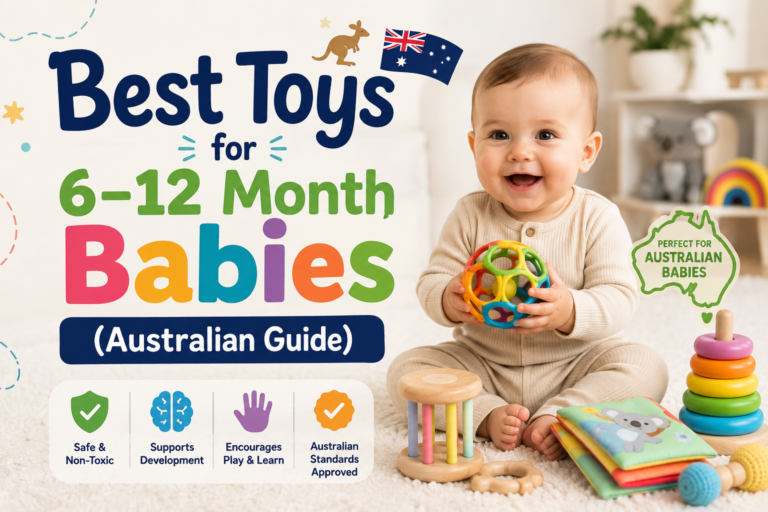
The workhorse of this stage. Look for open, latticed designs that small fingers can hook through, a solid smooth ball is genuinely difficult for a four-month-old to hold, and gets abandoned.
Varied surface texture is the point: ridged, smooth, bumpy and soft all give different sensory information.
AU price: $6–$20. Widely available at Kmart, Big W and Target.
2. Silicone teethers
Whether or not teeth are actually coming, your baby will chew. A teether gives them something appropriate to chew, and the material variety is useful in itself.
Buy one moulded piece with no glued-on beads, no fabric loops sewn to plastic, and no liquid filling if you can avoid it, water-filled teethers can split and leak.
Food-grade silicone, natural rubber and untreated hardwood are all appropriate. Avoid anything painted.
AU price: $4–$15 at Kmart and Big W, $20–$35 for boutique brands. There is no meaningful safety difference if the construction rule above is met.
Our full breakdown of teether materials and cleaning is in best baby teething toys in Australia.
3. A play gym with detachable toys
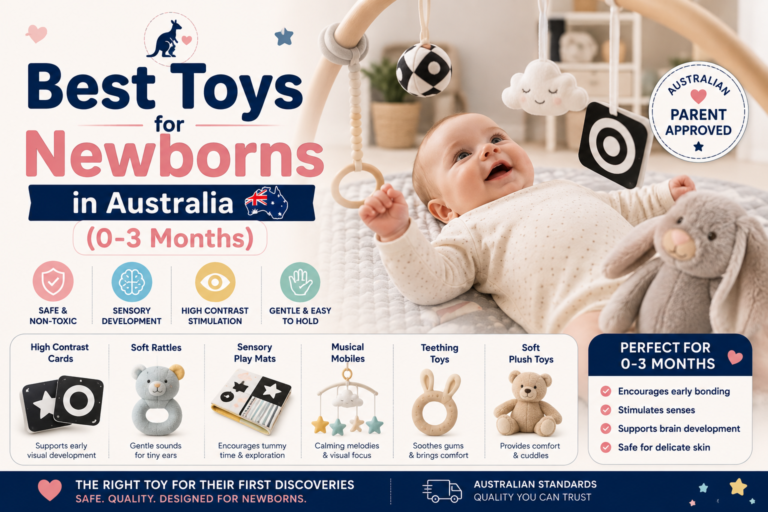
If you bought a play mat for the newborn stage, this is where it earns its keep properly. Lower the arch so hanging toys are within reach, and your baby will spend genuinely long stretches batting and grabbing.
Detachable is the key feature. Once your baby can hold things independently, the hanging toys become standalone toys and the product’s life doubles.
AU price: $45–$150.
4. Wrist and ankle rattles
Underrated, and excellent for cause and effect. The noise follows the movement, and over a few weeks your baby works out that they are causing it. That realisation is the foundation of everything they learn in the second half of the first year.
Choose soft fabric with a velcro or elastic fastening, and make sure the whole thing is machine washable.
AU price: $8–$18.
5. An unbreakable mirror
Still relevant, and now more useful than it was for a newborn. Tummy time is harder and more important in this window, your baby is building the neck and shoulder strength that rolling and sitting depend on, and a mirror is the most reliable way to extend it.
AU price: $15–$35.
6. Crinkle books and soft fabric books
Sound plus texture plus something graspable. Fabric books at this age are chew toys with pictures, and that is fine. Machine washable, always.
AU price: $10–$25.
7. Lightweight rattles with a handle
Now that your baby can hold things, a proper rattle finally makes sense. The critical spec is weight: light enough to lift and shake one-handed. Heavy wooden rattles look beautiful and get dropped immediately.
AU price: $8–$25.
What to skip at this stage
| Item | Why not yet | When it fits |
| Stacking cups and rings | Needs deliberate release, which comes around 8 months | 6–9 months |
| Shape sorters | Requires precision grasp and problem solving | 12–18 months |
| Push and walker toys | Baby is not weight-bearing yet | 9–12 months |
| Battery light-and-sound panels | Passive; your baby learns more from cause-and-effect they control | 8+ months |
| Small figurines and toy vehicles | Choking hazard, and no play value at this age | 18 months+ |
| Anything with glued-on beads or eyes | Detachment risk in a mouthing baby | Never for under-threes |
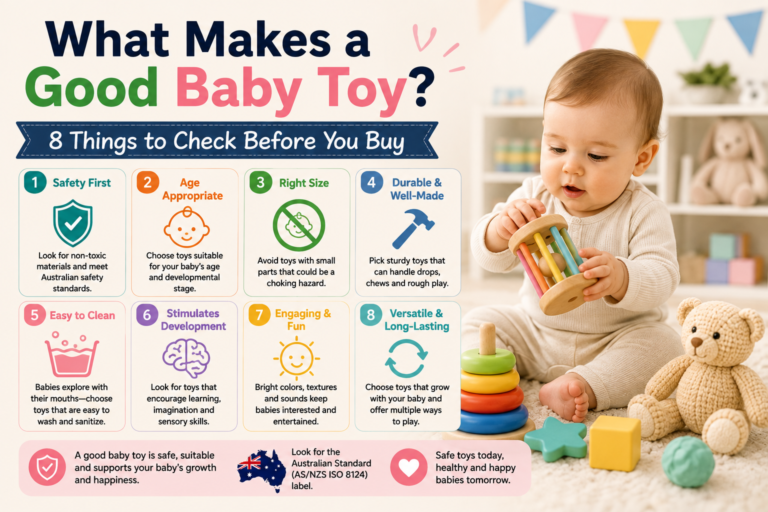
If you would rather judge toys yourself than follow age lists, the checklist in what makes a good baby toy covers the eight things worth checking on any purchase.
Safety at the mouthing stage
Mouthing changes the risk profile completely. From here until about age three, size is your primary safety filter.
Run these checks on every toy:
- The toilet roll test. If the toy, or any part that could come off, fits through a toilet roll tube, it is a choking hazard. This is the most useful home test there is, full detail in choking hazards and the small parts test.
- Pull-test every attached part. Sewn-on eyes, glued beads, ribbon tags. Tug firmly. If it moves, it will come off.
- Check for splitting. Water-filled teethers and soft plastic degrade with repeated chewing. Inspect weekly and bin anything cracked.
- No cords over 20 cm. Pram toy attachments, dummy chains, links. Strangulation risk.
- Confirm Australian compliance. Overseas-sold products are not automatically compliant here. The ACCC administers mandatory toy standards through Product Safety Australia.
For the complete standards breakdown and a printable safety checklist, see baby toy safety in Australia.
Cleaning: now genuinely important
At the newborn stage, cleaning was a weekly nice-to-have. Now every toy is being actively chewed, and drool volume increases sharply around four months.
A workable routine:
- Silicone and hard plastic: warm soapy water, rinse well, air dry. Every two to three days for heavily used items.
- Fabric toys and rattles: machine wash weekly on a gentle cycle in a laundry bag.
- Wooden toys: wipe with a damp cloth only. Never soak, wood swells, then splinters as it dries.
- When your baby is unwell: wash everything they have mouthed, then again once they have recovered.
You do not need a sterile environment or antibacterial sprays. Soap and water is sufficient, and harsh cleaners leave residue on something your baby will put in their mouth. Full method by material: how to clean baby toys properly.
What it costs in Australia
| Item | Budget | Mid-range |
| Textured grasping balls | $6 | $20 |
| Silicone teethers (set) | $8 | $30 |
| Play gym | $45 | $150 |
| Wrist rattles | $8 | $18 |
| Unbreakable mirror | $15 | $35 |
| Crinkle book | $10 | $25 |
| Total | $92 | $278 |
Most parents already own the play gym from the newborn stage, which brings the incremental cost of this stage down to around $50.
Prices are indicative for 2026 and vary by retailer and sale period.
Signs your baby is ready for the next stage
Move on when you see these, usually somewhere between six and eight months:
- Sitting unsupported, even briefly
- Deliberate dropping and releasing, this is the skill that makes stacking and posting toys work
- Interest in what happens next, banging a toy to hear the sound rather than just holding it
- Reaching for objects out of range, then moving towards them
At that point, switch to the cause-and-effect toys covered in best toys for 6–12 month babies.
Frequently asked questions
What toys are best for a 4 month old? Lightweight textured balls, silicone teethers, wrist rattles and a play gym with the arch lowered. Four months is roughly when voluntary grasping begins, so anything easy to hold in one hand works well.
Why does my 5 month old put everything in their mouth? Because the mouth has more nerve endings than the fingertips at this age, making it the most effective tool for investigating an object. It usually indicates curiosity rather than teething.
How many toys does a 3–6 month old need? Five or six accessible at a time is plenty. Rotating a small set every couple of weeks holds attention better than a large collection available all at once.
Are wooden or silicone teethers better? Both are safe. Silicone is easier to clean and more forgiving on gums; untreated hardwood is more durable and offers a firmer surface. Variety in material is genuinely useful, so many parents use both.
When do babies start playing with toys properly? Around four months, when reaching becomes deliberate. Before that, toys are things you use with your baby rather than things they play with.
Is it safe to buy secondhand toys for a baby this age? Yes, with two conditions: check the item against current Australian recall lists, and avoid anything with glued or sewn-on parts, since adhesives and stitching degrade with age and use.
How we choose the toys we recommend
Every recommendation is assessed against Australian safety standards, developmental fit for the stated age, durability under real use, washability, and value at current Australian retail prices. We prioritise products actually available to buy in Australia. Affiliate links, where used, are disclosed at the top of the article and do not affect ranking.
Sources referenced: Product Safety Australia (ACCC) for mandatory toy standards and recalls; Raising Children Network for developmental milestone ranges.