Baby Toys by Age: The Complete Australian Guide (0–3 Years)
Quick answer: Babies need different toys roughly every three months for the first year, then every six months until age three. Newborns (0-3 months) need high-contrast visual toys and soft rattles. Babies 3-12 months need grasping, mouthing and cause-and-effect toys. Toddlers 1-3 years need stacking, pretend play and gross motor toys. In Australia, expect to spend $15-$60 per quality toy, and check every purchase against the ACCC small-parts rule for under-threes.
Key takeaways
- A toy is “right” when it sits just above your baby’s current skill, not at it. Too easy and they ignore it; too hard and they get frustrated.
- Under three years old, size is the number one safety filter. If a toy or any part of it fits through a toilet roll tube, it is a choking risk.
- You need far fewer toys than the shops suggest. Four to six well-chosen toys in rotation beat a bin full of forty.
- Australian pricing varies wildly for identical products. The same wooden stacker can be $12 at Kmart and $49 at a boutique. Material and finish quality are what you are actually paying for.
- Age labels on packaging are safety ratings, not development advice. “3+” almost always means small parts, not that the toy is too advanced.
Walk into any Australian toy aisle with a six-month-old on your hip and the choice is paralysing. Hundreds of products, all of them promising to make your baby smarter, calmer or more coordinated. Very few of them tell you the thing you actually want to know: is this right for my baby, right now?
This guide answers that. We have broken the first three years into the six stages that matter developmentally, explained what your baby is learning in each one, and matched toy types to those skills. Where relevant we have included realistic Australian pricing and flagged the safety rules that apply specifically here,which differ from the American advice that dominates search results.
How toy needs actually change in the first three years
Babies do not develop in a smooth line. They develop in bursts, and each burst unlocks a new way of playing.
For roughly the first twelve weeks, a baby’s play is almost entirely visual and auditory, they are looking and listening, not doing. From around three months, hands come into it: reaching, then grasping, then deliberately releasing. Somewhere between eight and twelve months, most babies work out cause and effect (“if I press this, it makes noise”), which is the single biggest shift in the first year and changes what they want from a toy completely.
After the first birthday, play becomes constructive, stacking, posting, nesting, sorting. By two, it becomes imaginative, and a wooden block stops being a block and starts being a phone, a car, or a piece of toast.
The practical implication: a toy that is a hit for eight weeks can become invisible overnight. That is normal, and it is why toy rotation works better than toy buying. We cover the system in our guide to toy rotation and reducing clutter.
The one rule that replaces most buying advice: buy for the skill your baby is working on, not the skill they have mastered. A baby who can already sit is ready for toys that reward crawling.
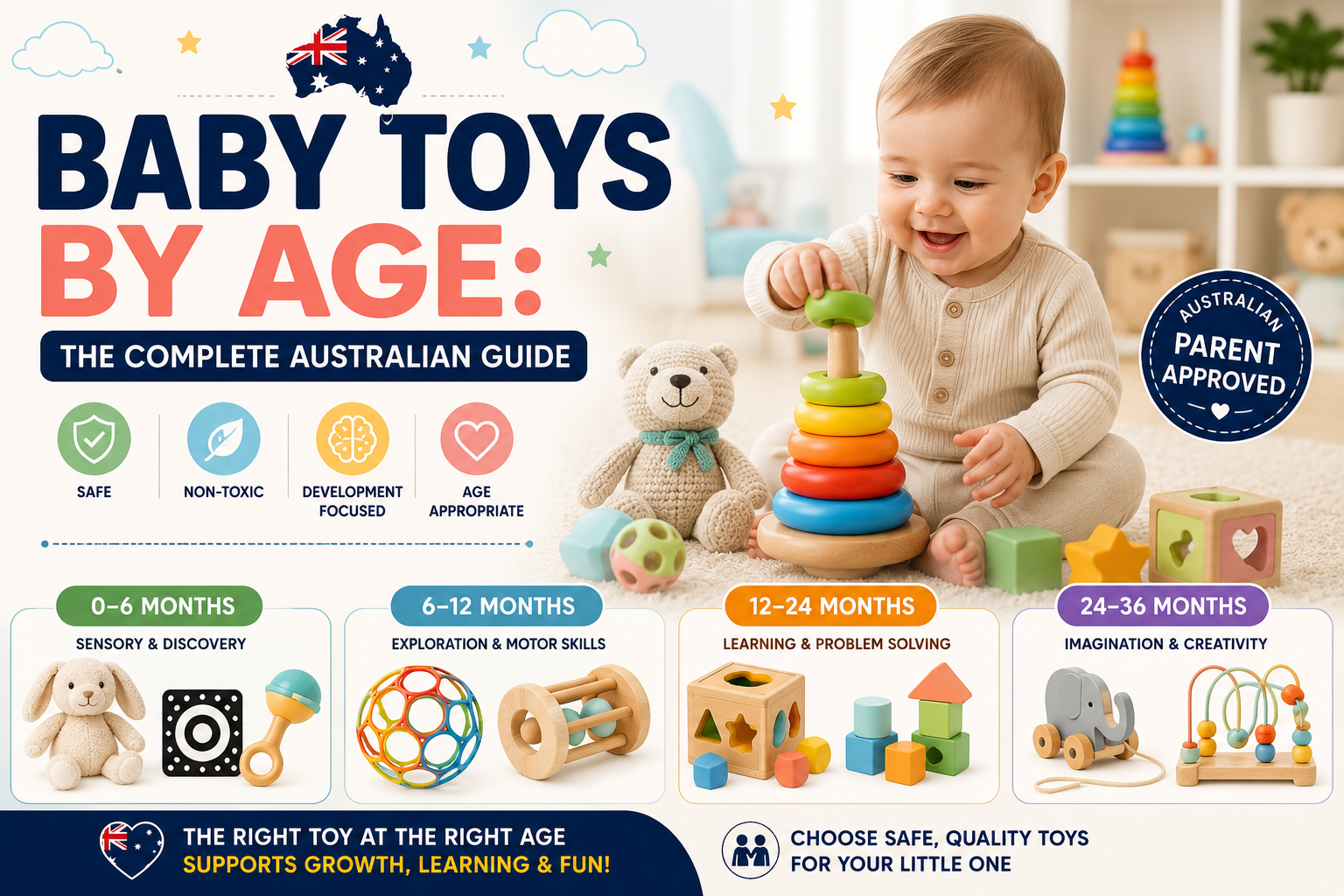
Baby toys by age: the quick reference table
| Age | What they are learning | Toy types that fit | Typical AU spend |
| 0-3 months | Focusing, tracking, hearing | High-contrast cards, mobiles, soft rattles, play mat | $20-$80 |
| 3-6 months | Reaching, grasping, mouthing | Teethers, textured balls, wrist rattles, play gym | $15-$70 |
| 6-12 months | Sitting, crawling, cause and effect | Stacking cups, ball drops, push toys, board books | $20-$60 |
| 12-18 months | Walking, posting, first words | Shape sorters, walker wagons, chunky puzzles | $25-$90 |
| 18-24 months | Problem solving, imitating | Ride-ons, simple instruments, pretend food | $30-$120 |
| 2-3 years | Imagination, fine motor, social play | Play kitchens, block sets, craft, dolls, trains | $30-$150 |
0-3 months: high contrast, soft sound, and not much else
A newborn’s vision is blurry and largely monochrome for the first several weeks, with a focal range of about 20-30 cm, roughly the distance from your chest to your face. This single fact should determine everything you buy.
What works at this stage:
- High-contrast black-and-white cards or books: The cheapest genuinely useful baby toy there is. Prop them beside the change table and beside the play mat.
- A play mat or gym with a low arch: Not for the dangling toys initially, for the flat, safe surface it gives you for tummy time.
- Soft rattles and crinkle toys: Your baby cannot hold them yet. You shake them, just off-centre, and they learn to turn towards sound.
- A single mobile: Slow-moving, high contrast, and positioned to the side of the cot rather than directly overhead.
What to skip: anything battery-powered with lights and multiple sound modes, anything marketed as “educational”, and the enormous plush teddy that a well-meaning relative will inevitably buy anyway.
Tummy time is the most valuable “activity” of this stage and most babies hate it. The toys that help are the ones placed at eye level in front of them, a mirror, a roller, a crinkle book. Our full breakdown of what works is in best tummy time toys for babies in Australia.
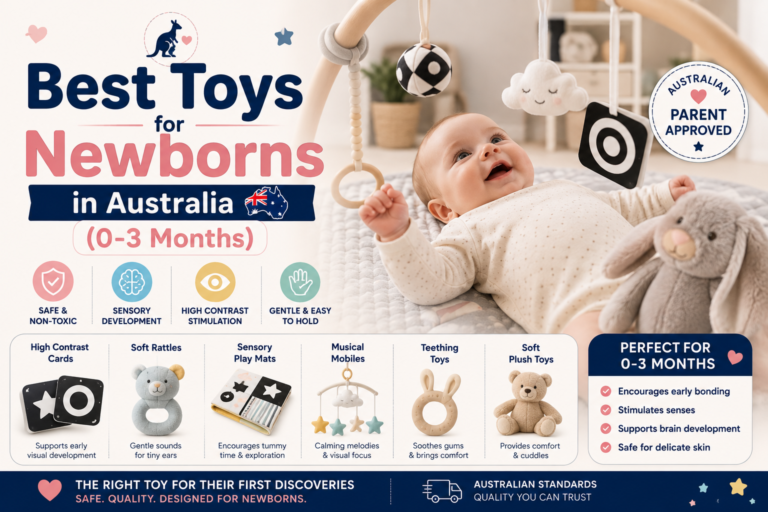
For a full list of tested newborn picks with Australian stockists, see best toys for newborns in Australia (0-3 months).
Safe sleep note: Red Nose Australia advises that cots stay clear of soft toys, bumpers and loose items for sleep. Cot mobiles come off once your baby can push up on hands and knees. We go into the detail in cot toys: what’s safe for a sleeping baby.
3-6 months: hands take over
This is the stage where your baby discovers they have hands and that hands can be aimed. Grasping becomes deliberate somewhere around four months, and everything grasped goes straight into the mouth, not because your baby is teething necessarily, but because the mouth is the most sensitive tool they have for investigating an object.
Design your buying around that. Every toy at this stage should be washable, non-toxic, and too large to swallow.
What works:
- Textured grasping balls and rings: Look for something a small hand can hook fingers through, solid spheres are surprisingly hard for a four-month-old to hold.
- Teethers in varied materials: Silicone, natural rubber and untreated timber all feel different, and variety is the point.
- A play gym with detachable toys: Detachable matters: it doubles the life of the product once your baby can hold things independently.
- Wrist and ankle rattles: Excellent for cause and effect, the noise follows the movement, and your baby works out the connection.
- An unbreakable mirror: Endlessly interesting, and useful for tummy time.
Australian pricing here is generous: Kmart and Big W both carry perfectly safe silicone teethers and textured balls in the $4-$12 range, and there is no meaningful safety gap between those and a $30 boutique equivalent, provided the item is a single moulded piece with no glued-on parts.
Full picks: best toys for babies 3–6 months old and, for teething specifically, best baby teething toys in Australia.
6-12 months: the cause-and-effect year
If there is one stage where the right toy makes a visible difference, it is this one. Your baby becomes mobile, discovers object permanence, the understanding that things still exist when hidden, and starts to experiment deliberately rather than randomly.
What works:
- Stacking cups: The single best value toy of the first year. They stack, nest, hide things, get chewed, go in the bath, and survive being thrown.
- Ball drop and hammer toys: The purest form of cause and effect: put in, thing happens.
- Push-along and walker toys: Choose one with adjustable resistance or a weighted base, a lightweight walker shoots away from a new walker and causes falls.
- Board books with flaps: Object permanence in book form.
- Simple pop-up or peek-a-boo toys.
Watch for the pincer grasp developing around nine to ten months, thumb and forefinger together. It is a milestone worth celebrating and also the moment your home becomes significantly more dangerous, because your baby can now pick up anything small enough to choke on.
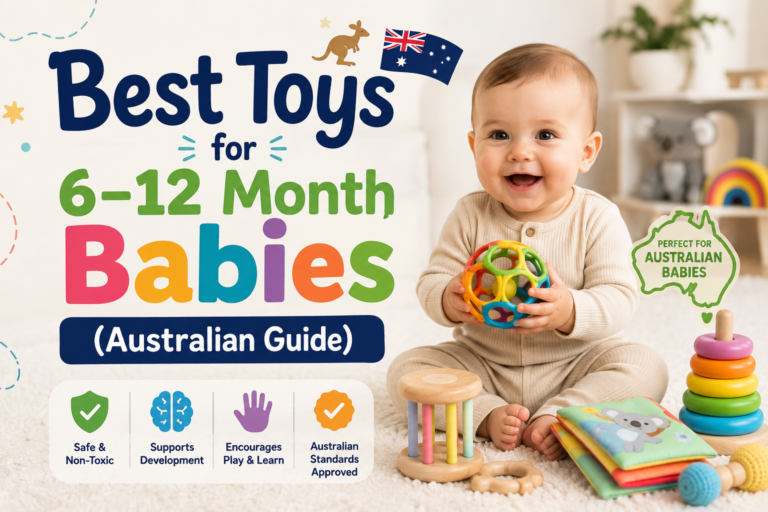
Full picks: best toys for 6-12 month babies.
Coming up to a first birthday and being asked what to buy? First birthday gift ideas: 25 toys that get played with is the list we send to grandparents.
12-18 months: posting, stacking and walking
Your baby is now a toddler, technically, and their play changes from “what does this do” to “what can I do with this”. Fine motor control improves sharply, and toddlers develop a near-obsessive interest in putting things into other things.
What works:
- Shape sorters: Start with a two- or three-shape sorter, not the ten-shape version. Frustration kills interest fast.
- Chunky knob puzzles: Four to six pieces maximum at this age.
- Stacking rings and simple block sets.
- Walker wagons: More stable than a push toy and useful for carrying things around, which toddlers love disproportionately.
- Bath toys with cups and pourers: Water play is fine motor practice with the mess contained.
This is also the age where toy noise becomes a household issue. Check for a volume switch before buying anything with a speaker, and be aware that some electronic toys measure above 85 dB at close range, loud enough to be a genuine hearing concern when held near the ear.
Full picks: best toys for 1 year olds in Australia.
18-24 months: imitation begins
Somewhere in this window your toddler starts copying you, and it changes their play completely. They want a toy phone because you have a phone. They want to sweep because you sweep. This is the beginning of pretend play and it is worth leaning into, because imitative play builds language faster than almost anything else you can buy.
What works:
- Realistic miniatures: Toy phones, brooms, keys, handbags, toy food.
- Ride-on toys: Feet-on-the-ground ride-ons first; balance bikes generally suit closer to two and a half.
- Simple musical instruments: Drums, shakers, a xylophone.
- Large-piece construction blocks.
- Sandpit and water table toys: Particularly useful given how much of the Australian year is spent outdoors.
Toddlers in this window also start to show clear preferences, and it is worth following them. A child fixated on trucks will learn more from truck play than from the developmentally “correct” toy they are ignoring.
Full picks: best toys for 2 year olds in Australia and best toddler toys in Australia (12-36 months).
2-3 years: full imagination
By two, pretend play is running the show. Blocks become buildings, dolls have conversations, and your child can sustain a made-up scenario for genuinely impressive stretches of time. Fine motor skills are good enough for threading, chunky crayons and simple craft.
What works:
- Play kitchens and shop sets: High initial cost, but among the longest-lasting toys you will buy, many children use them until five or six.
- Larger block and magnetic tile sets.
- Train sets and vehicle play.
- Dolls, soft toys and small-world figures for narrative play.
- First craft supplies: Chunky crayons, large-bead threading, playdough.
Full picks: best toys for 3 year olds in Australia, plus our age-by-age breakdowns for girls and boys, both written without the usual pink-and-blue assumptions, and best toys for 4 year old boys for the stage just beyond this guide.
Baby toy safety in Australia: the four checks that matter
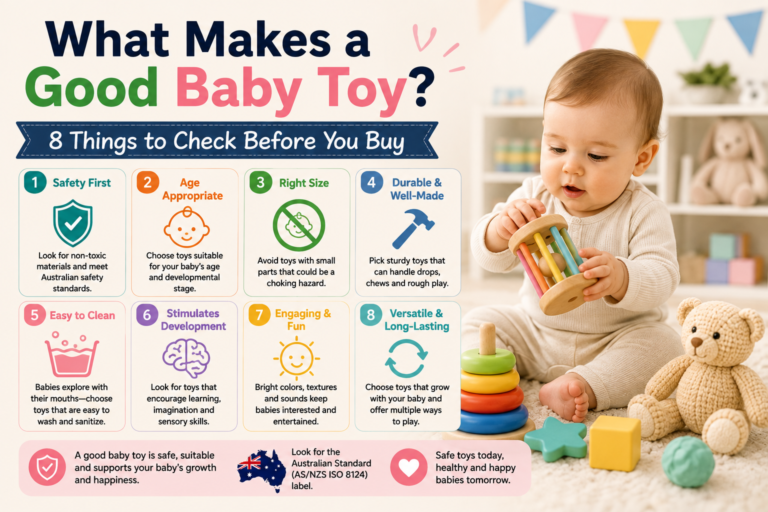
Australian toy safety rules are not identical to those in the US or UK, and a product legally sold overseas is not automatically compliant here. The ACCC administers mandatory standards through Product Safety Australia, and the relevant standard for most toys is AS/NZS ISO 8124.
Run these four checks on every toy before it reaches your baby:
- The small parts test: If the toy, or any piece that could detach, fits through a toilet roll tube, it is a choking hazard for under-threes. This is the single most useful test you can do at home. Detail: choking hazards and the small parts test.
- Button batteries: Australia has mandatory standards requiring secured battery compartments, but older and imported toys often do not comply. A swallowed button battery can cause serious internal burns within hours. Detail: button batteries in toys.
- Magnets: Small high-powered magnets are dangerous if more than one is swallowed. Detail: magnets in toys.
- Cords and loops: Anything longer than about 20 cm is a strangulation risk in a cot or pram. Pram toy attachments should be short and taut.
For the complete standards breakdown, recall checking and a printable checklist, read our baby toy safety in Australia guide.
Check recalls before buying secondhand. Marketplace and op-shop toys are excellent value and completely reasonable to buy, but they predate current standards more often than new stock does. How to check Australian toy recalls.
How many toys does a baby actually need?
Fewer than you think. Research on toddler play consistently finds that children with fewer toys available at once play for longer with each one and play more creatively.
A practical target for the first year: six to eight toys accessible at any time, rotated every couple of weeks from a larger stored set. Store the rest out of sight, not out of the house, just out of sight. Reintroduced toys get treated as new.
Storage is the piece most parents underestimate, and it becomes urgent around the first birthday. Our toy storage ideas guide covers systems that work in small Australian homes and apartments.
Where to buy baby toys in Australia
| Retailer | Best for | Watch out for |
| Kmart | Budget basics, bath toys, sensory items, wooden toys | Finish quality on timber varies; check for rough edges |
| Big W | Mid-range brands, sale periods, wide baby range | Full-price items are rarely the best value, wait for the toy sale |
| Target | Curated mid-range, occasional strong clearance | Smaller baby-specific range than Big W |
| Bunnings | Storage solutions, outdoor and sandpit gear | Not a toy retailer, no toy-specific safety guidance in-store |
| Independent AU stores | Montessori, wooden and heirloom toys | Higher prices; verify the material and finish claims |
| Marketplace / secondhand | Big-ticket items like play kitchens and ride-ons | Check recalls; avoid secondhand items with battery compartments |
Timing matters more than store choice for anything expensive. Australian toy discounting is highly seasonal, the toy sale calendar is worth checking before you buy a play kitchen or ride-on at full price.
Five mistakes worth avoiding
- Buying ahead: A toy bought for the stage after the current one usually gets ignored, then forgotten by the time it fits.
- Confusing “educational” with useful: The word is unregulated in toy marketing. A set of stacking cups is more educational than most products carrying the label.
- Buying the ten-shape sorter first: Difficulty should ramp, not start at the top.
- Treating age labels as development advice: “3+” is usually a small-parts warning.
- Ignoring washability. Everything at this age gets mouthed. If it cannot be wiped down or machine washed, it will not last.
Frequently asked questions
When should I start giving my baby toys? From birth, though “toys” at that stage means high-contrast cards, your face, and soft rattles you shake for them. Deliberate grasping does not develop until around four months, so before that the toy is really a tool for you to use with your baby.
How many toys does a 1 year old need? Six to eight accessible at a time is plenty, rotated every two to three weeks. Fewer toys in view generally means longer, deeper play with each one.
Are wooden toys better than plastic for babies? Not automatically. Well-made wooden toys last longer and have no battery or speaker to fail, but wood can splinter as it ages and is harder to sterilise. Good plastic is safe, cheap and washable. Finish quality matters more than material. We compare them properly in wooden toys vs plastic toys.
How do I know if a toy is safe for my baby in Australia? Check three things: that no part fits through a toilet roll tube, that any battery compartment is screw-secured, and that there are no cords over about 20 cm. Then check the product against the recall list on productsafety.gov.au.
How often should baby toys be cleaned? Mouthed toys need a wipe-down every few days and a proper wash weekly, more often if your baby is unwell. Bath toys are the exception, they need attention far more often because of internal mould. See how to clean baby toys properly.
What should I look for when choosing any baby toy? Size, material, washability, noise level, and whether it sits just above your baby’s current ability. We expand this into a full checklist in what makes a good baby toy.
How we choose the toys we recommend
Every toy in our guides is assessed against the same criteria: compliance with Australian safety standards, developmental fit for the stated age, durability under real use, washability, and value at current Australian retail prices. We prioritise products actually available to buy in Australia rather than US-only recommendations, and we note when something is only worth buying on sale.
Where a guide includes affiliate links, they are marked and disclosed at the top of the article. Being an affiliate product does not affect whether or how highly we rank it.