Best Toys for 4 Year Old Boys in Australia
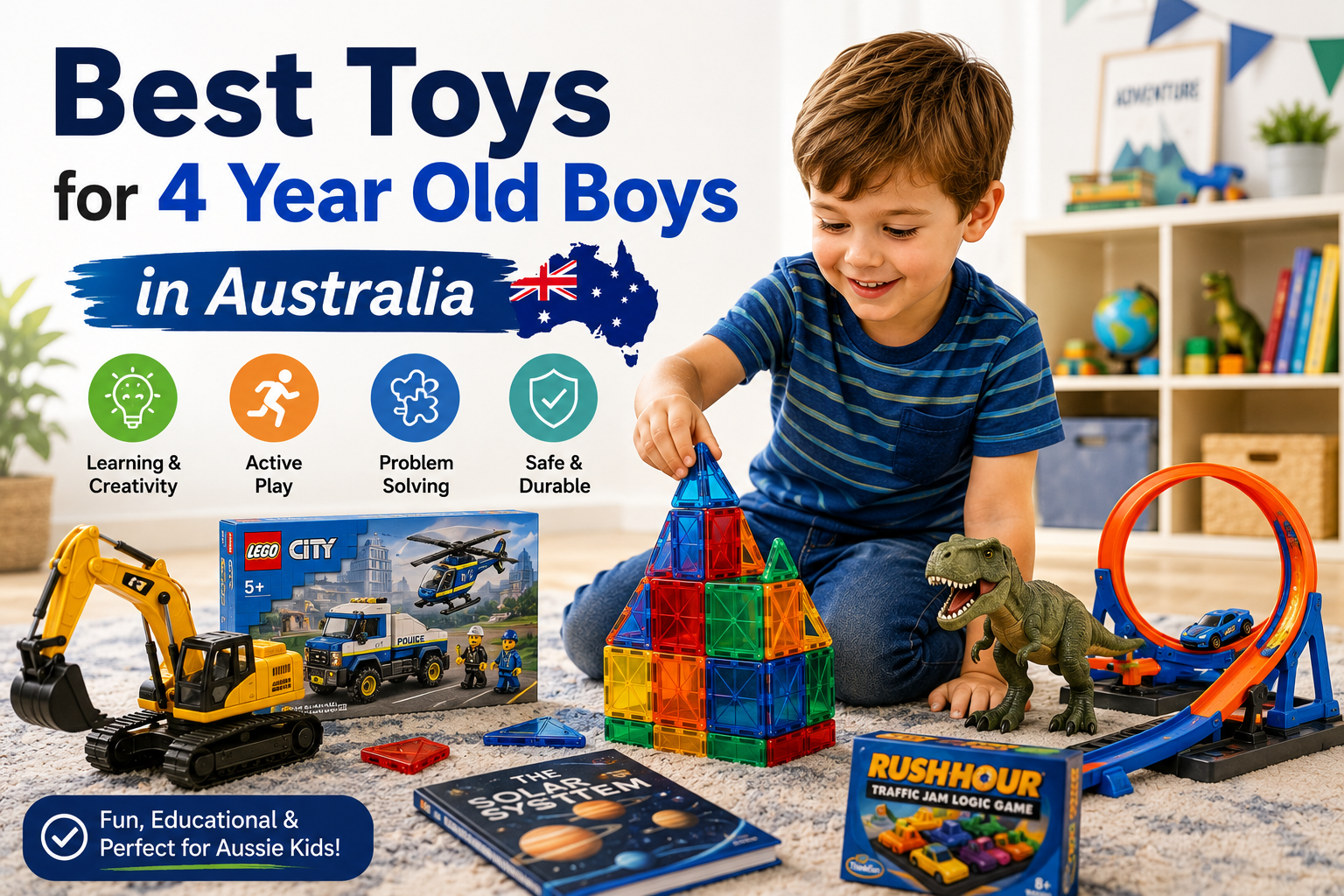
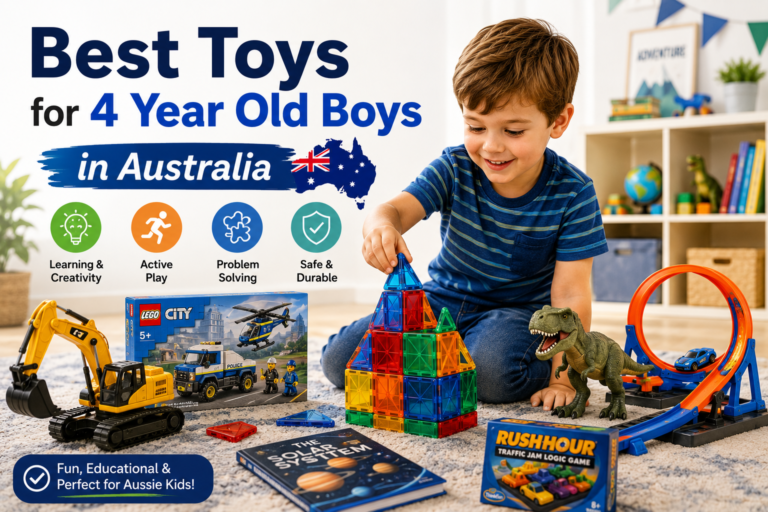
Quick answer: Four year olds can follow rules, build from instructions, and sustain a game for half an hour. The best toys at this age are standard construction bricks, a first pedal bike or scooter, simple STEM and building kits, sports gear, and competitive games short enough to finish. Budget $30–$250 per item in Australia.
Key takeaways
- Four is when construction gets serious. Standard-size bricks and kits with instructions become genuinely achievable.
- Competitive games finally work losing is still hard, but manageable in a game that lasts under twenty minutes.
- A pedal bike is the standout purchase if your child has mastered a balance bike. Many skip training wheels entirely.
- Buy for the interest, not the aisle. A four year old’s preferences are already specific, and they rarely match the shop’s categories neatly.
- Most “STEM” labelling is marketing. A plain set of bricks does more for spatial reasoning than most branded science kits.
Four is the age where toys stop being about development stages and start being about interests. Your child now has genuine opinions, can concentrate for a decent stretch, and will tell you at length what they want.
This guide covers what a four year old can actually do, what holds up, and what to skip. It sits inside our wider baby toys by age guide.
A quick note on boys toys
Worth thirty seconds, because it makes you a better buyer.
By four, most children have absorbed strong ideas about which toys belong to whom largely from packaging, advertising and what they see other children given. Those preferences are real and worth respecting. But they are also narrower than the child’s actual interests.
The practical version: buy for what your child is actually into, not what the aisle says. Plenty of four year old boys want a play kitchen, a doll or a craft set, and will use them heavily. Plenty want diggers and nothing else. Both are fine, and you will get better value from watching your child for a week than from any category label.
Everything below is chosen for what a four year old can do, not for who it is marketed to. Our age-by-age guides for boys and girls take the same approach across the whole age range.
What a four year old can do
Concentration extends. Twenty to thirty minutes on a single activity is realistic, which changes what is worth buying. Multi-step projects become viable.
Instructions become followable. A four year old can generally build a simple model from picture instructions. This is new, and it is why construction sets land so well at this age.
Rules and competition work. Cooperative play was the three-year-old milestone; competing is the four-year-old one. Losing is still difficult, but a short game is survivable.
Fine motor is preschool-ready. Most four year olds use scissors reasonably, draw recognisable figures, and are developing a proper tripod pencil grip. Some begin writing their name.
Physically, running, jumping, climbing and ball skills are all solid. Many four year olds ride a pedal bike, and most manage a scooter well.
The best toys for 4 year olds
1. Standard construction bricks
The highest-value category at this age, comfortably. Four is when standard-size bricks become manageable and instruction-following clicks.
Buy a plain brick set over a themed model kit. Model kits get built once and shelved. Loose bricks get rebuilt for years. If you buy a themed set, treat it as bricks with a picture on the box.
AU price: $40–$150.
2. A first pedal bike
The standout purchase of this year if your child has used a balance bike. Children who master balancing usually skip training wheels altogether and ride within a day or two.
Check: both feet flat on the ground when seated, and hand brakes your child can actually squeeze. A helmet is legally required for riding a bicycle on Australian roads and paths.
AU price: $120–$300. Excellent secondhand children outgrow bikes long before bikes wear out.
3. Simple STEM and building kits
Marble runs, gear sets, simple circuits, magnetic construction. The good ones are genuinely open-ended and reconfigurable.
See the STEM section below before spending a lot of this category is packaging.
AU price: $30–$120.
4. Sports and gross motor gear
Balls, a small basketball hoop, cricket set, frisbee, skipping rope. Cheap, heavily used, and well suited to the amount of outdoor time an Australian four year old gets.
AU price: $20–$80.
5. Small-world play now with narrative
Figures, vehicles, dinosaurs, a garage, a farm, a construction site. Play at four is elaborate and story-driven, running for half an hour or more.
Mixed sets from different sources work fine. Secondhand is excellent here.
AU price: $25–$100.
6. Short competitive and cooperative games
Under twenty minutes, minimal reading, simple rules. Card games, matching games, simple race games.
Keep some cooperative games in rotation too. Even at four, a run of losses ends the session.
AU price: $15–$40.
7. Craft, drawing and writing materials
Pencils, scissors, glue, stickers, stencils, a whiteboard. Pre-writing practice that does not look like practice.
AU price: $20–$50.
Choosing a first pedal bike in Australia
The most expensive item most families buy at this age, and the easiest to get wrong.
| Check | What to look for |
| Wheel size | 14″ or 16″ suits most four year olds. Measure the child, not the age on the box |
| Standover height | Both feet flat on the ground when seated, comfortably |
| Brakes | Hand brakes your child can squeeze with one hand. Test in the shop |
| Weight | Lighter is genuinely better. A heavy bike is hard to control and harder to pick up |
| Training wheels | Skip them if your child used a balance bike. Adding them can undo the balance skill |
| Helmet | Legally required for bicycles on Australian roads and paths. Fit it properly two fingers above the eyebrows, snug strap |
Buying secondhand makes obvious sense here. Bikes are outgrown in eighteen months and rarely worn out. Check brakes and tyres, and buy the helmet new helmets are single-impact items and you cannot see internal damage.
STEM kits: what is worth it, what is marketing
“STEM” is an unregulated label in toy marketing. It appears on plenty of products that teach nothing in particular.
Generally worth it:
- Marble runs cause and effect, gravity, spatial planning, endlessly reconfigurable
- Gear and cog sets mechanical reasoning, visible and immediate
- Magnetic tiles geometry and structure, and they carry over from age two
- Plain construction bricks the most-used building toy in most homes, and it does not carry the label
Usually not worth it:
- Single-outcome “experiment” kits one volcano, done, box in the cupboard
- Screen-linked coding toys at this age abstraction is years away
- Anything where the electronics do the work and the child watches
The test: can it be built more than one way? If yes, it will be used again. If there is one correct outcome, it is a single afternoon.
What to skip at four
| Toy | Why |
| Themed model kits | Built once, shelved. Loose bricks last years |
| Long or complex board games | Attention runs out around twenty minutes |
| Single-experiment science kits | One use, poor value per hour |
| Electronic learning tablets | Still passive, still the worst cost per year |
| Licensed versions of generic toys | Same play, up to three times the price |
| Toys with small parts, if a toddler lives here | The rule applies to the house, not the child |
Safety at four
- Helmets for wheeled toys. Legally required for bicycles on Australian roads and paths. State rules for scooters differ from bicycle rules check your state, and use one regardless.
- Small parts, if there is a younger sibling. Construction bricks and small-world figures are the main culprits. Full method: choking hazards and the small parts test.
- Magnets. Construction and STEM sets frequently contain small high-powered magnets. More than one swallowed is a medical emergency. Magnets in toys.
- Button batteries in light-up toys, novelty items and party favours. Compartments must be screw-secured.
- Craft supplies check glue, paint and markers are non-toxic and age-labelled.
Full Australian standards breakdown and printable checklist: baby toy safety in Australia.
What it costs in Australia
| Item | Budget | Mid-range |
| Construction bricks | $40 | $150 |
| Pedal bike + helmet | $150 | $350 |
| STEM or building kit | $30 | $120 |
| Sports gear | $20 | $80 |
| Small-world set | $25 | $100 |
| Games (2) | $30 | $80 |
| Craft supplies | $20 | $50 |
| Total | $315 | $930 |
Secondhand is strongest at this age for bikes, construction bricks and small-world figures none of which degrade in any way that matters. Buy helmets new.
Prices are indicative for 2026 and vary by retailer and sale period.
Frequently asked questions
What are the best toys for a 4 year old boy?
Standard construction bricks, a pedal bike, a marble run or gear set, and sports gear. Four is when instruction-following and multi-step building become achievable, so construction toys get heavy use.
When can a child ride a pedal bike without training wheels?
Most children who have used a balance bike can ride a pedal bike without training wheels at around four, often within a day or two of trying. Adding training wheels can actually undo the balancing skill they already have.
Are STEM toys worth buying for a 4 year old?
The open-ended ones are. Marble runs, gear sets and magnetic tiles can be built many ways and get repeated use. Single-outcome experiment kits are usually one afternoon. The test is whether it can be built more than one way.
What size bike does a 4 year old need in Australia?
Most four year olds suit a 14″ or 16″ wheel, but measure rather than assume both feet should sit flat on the ground when seated, and your child should be able to squeeze the brakes with one hand.
Should I buy gendered toys for my 4 year old?
Buy for your child’s observed interests rather than the category on the shelf. Preferences at four are real and worth respecting, but they are usually narrower than what the child actually enjoys when given the chance.
How much should I spend on toys for a 4 year old?
Around $315 covers a full year’s worth at budget Australian pricing, with the bike as the main expense. Buying the bike and construction bricks secondhand cuts that substantially.
How we choose the toys we recommend
Every recommendation is assessed against Australian safety standards, developmental fit for the stated age, durability under real use, and value at current Australian retail prices. We prioritise products actually available to buy in Australia. Affiliate links, where used, are disclosed at the top of the article and do not affect ranking.
Sources referenced: Product Safety Australia (ACCC) for mandatory toy standards, magnet and small parts rules; Kidsafe Australia for helmet and bicycle guidance; Raising Children Network for developmental milestone ranges.