When Can Babies Use a Shape Sorter? A Parent’s Guide
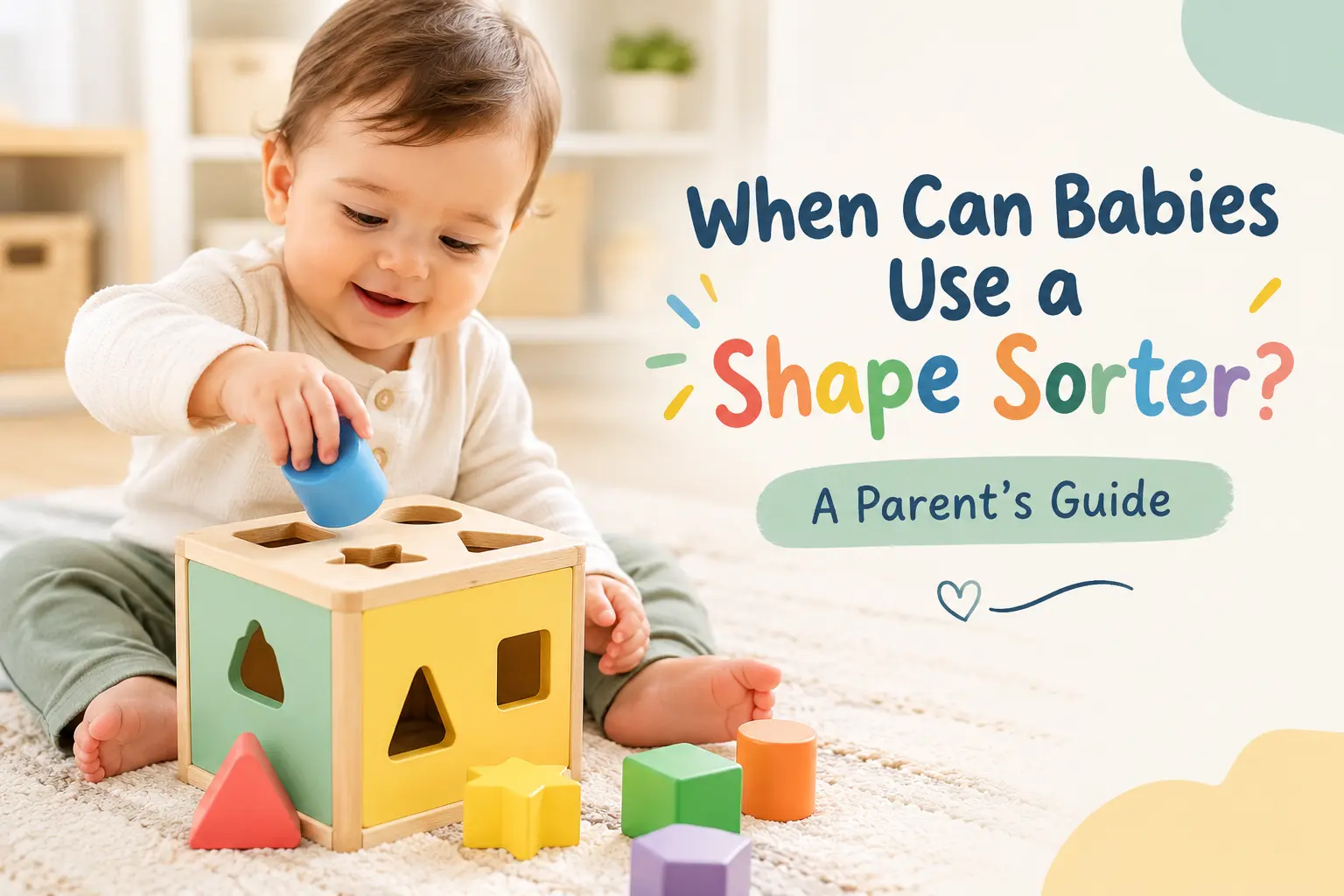
When Can Babies Use a Shape Sorter? Babies can start exploring simple shape-sorting activities at around 12 months, although readiness varies from child to child. Before that age, babies can enjoy age-appropriate toys that encourage reaching, grasping, and placing large objects into containers under close adult supervision.
If you are wondering when can babies use a shape sorter, look for signs that your child enjoys handling objects, releasing them into containers, and exploring how things fit together. This guide explains the right age to introduce a shape sorter, how to choose a safe toy, and how to help your baby learn through play.
Key Takeaways
- Around 12 months: Many babies begin enjoying simple container activities that prepare them for shape sorting.
- Between 12 and 18 months: A basic shape sorter with a few large, easy-to-handle pieces can be a suitable starting point.
- Readiness matters: Your baby does not need to recognise shapes or fit every piece correctly before starting.
- Learning happens through play: Shape sorters encourage hand-eye coordination, fine motor practice, exploration, and early problem-solving.
- Safety comes first: Choose toys designed for your child’s age, avoid hazardous small parts, and supervise play.
- Progress should be gradual: Introduce a few shapes first, then offer more challenging sorting activities as your toddler gains confidence.
What Is a Shape Sorter?
A shape sorter is an educational toy with openings that match specific shapes, such as circles, squares, triangles, or stars. Children handle the pieces and explore how each one fits into the corresponding opening.
A shape sorter usually includes a container or board and several removable pieces. Some toys have simple openings, while others include more complex shapes, colours, rotating sections, or additional activities.
For babies and young toddlers, the simplest designs are often the most useful. They provide opportunities to grasp, turn, release, and explore objects without requiring advanced problem-solving skills.
Shape sorters also allow parents to introduce basic words naturally. You can name a shape, describe its colour, or explain what happens when a piece drops into the container.
The goal is not to teach every shape immediately. Instead, the toy gives your child a safe opportunity to explore how objects work.
When Can Babies Use a Shape Sorter?
Babies can generally begin exploring simple shape sorters around their first birthday, provided the toy is designed for their age and they can handle its pieces safely. Some children enjoy basic matching earlier, while others need more time to develop the coordination required to fit shapes into openings.
The US Centers for Disease Control and Prevention (CDC) lists putting an object into a container, such as a block into a cup, as a cognitive milestone by 1 year. This is a useful developmental clue, although it does not mean every 1-year-old is ready to complete a traditional shape sorter.
What is the right shape sorter age?
There is no single age that suits every child. The following ranges are practical starting points, not strict developmental deadlines.
| Age | Suitable activity | What to expect |
|---|---|---|
| 6–9 months | Grasping and exploring age-appropriate toys | Reaching, holding, and transferring objects |
| 9–12 months | Supervised container play with large, safe objects | Dropping objects into containers and taking them out |
| 12–18 months | A simple shape sorter with a few large pieces | Exploring openings and attempting to fit shapes |
| 18–24 months | A basic sorter with more shapes | Increasingly purposeful matching and turning |
| 2–3 years | More varied sorting and matching games | Practising shape recognition, colour matching, and simple problem-solving |
These ranges are general guidance, not a promise that a child will perform a particular skill at a certain age. Always follow the toy manufacturer’s age recommendation and safety instructions.
Can a 6-month-old baby use a shape sorter?
A traditional shape sorter is generally not the best starting point for a 6-month-old. At this age, focus on toys made for infants that encourage reaching, grasping, and sensory exploration.
You can introduce the idea of putting things into containers later, when your baby can handle suitable objects safely. Never give an infant loose sorting pieces that could present a choking hazard.
Is a shape sorter for a 1 year old a good choice?
Yes. A simple shape sorter for a 1 year old can be a useful play option when it matches the child’s abilities and has no hazardous small parts.
Start with a sturdy toy and a small number of large pieces. Show your child how to hold a piece and move it towards an opening. Your toddler may put pieces into the container without matching their shapes at first. That is a perfectly reasonable way to explore the toy.
Do not expect your child to identify circles, squares, or triangles straight away. Early play is about handling objects, experimenting, and discovering what happens.
How Do You Know If Your Baby Is Ready for a Shape Sorter?
Your baby may be ready to explore a shape sorter when they show interest in objects, grasp them deliberately, and enjoy putting things into containers or taking them out. These behaviours offer more useful guidance than age alone.
Watch how your child plays during everyday activities. For example, a baby who repeatedly puts a large block into a cup and removes it is already exploring an important part of sorting play.
Look for these signs:
- Your baby reaches for toys and holds them deliberately.
- Your child can release objects rather than only gripping them.
- Your baby enjoys placing suitable objects into a container.
- Your toddler watches how you use a toy and tries to copy you.
- Your child remains interested when an object does not fit immediately.
Your baby does not need to show every sign before trying an age-appropriate toy. Introduce the activity gently and see how your child responds.
If the toy causes frustration, simplify the activity. Let your baby explore the pieces or use a container game instead. You can try the sorter again later.
Development varies, and a child who cannot complete a sorting task is not necessarily behind. If you have concerns about your baby’s development, speak with your child’s healthcare professional.
What Skills Do Babies Learn From Shape Sorters?
Shape sorters give babies and toddlers opportunities to practise fine motor movements, hand-eye coordination, object exploration, and early problem-solving. They also create opportunities for parents to introduce simple language about shapes, colours, size, and position.
However, the toy does not automatically teach every skill. Children benefit from handling the pieces themselves, trying different approaches, and interacting with a responsive adult.
1. Fine motor skills
Fine motor skills involve small movements of the hands and fingers. Holding a piece, turning it, and releasing it into an opening gives your child practice controlling these movements.
2. Hand-eye coordination
Your toddler needs to look at a piece and guide it towards the opening. Repeated attempts give them opportunities to coordinate what they see with how they move their hands.
3. Early problem-solving
A piece may not fit when held at the wrong angle. Your child can turn it, move it, or try another opening.
These attempts encourage exploration. Your toddler does not need to solve the puzzle independently for the activity to be worthwhile.
4. Shape and colour awareness
You can introduce words such as “circle”, “square”, “red”, and “blue” while playing. At first, your baby may respond by looking, touching, or reaching rather than naming the shapes.
5. Spatial awareness
A shape sorter introduces simple ideas about position, direction, and how objects fit into spaces. Your child begins exploring these relationships through movement and repetition.
6. Cause-and-effect learning
When a piece passes through an opening and lands inside the container, your child sees the result of their action. Repeating the activity helps them explore the relationship between what they do and what happens next.
How Do You Introduce a Shape Sorter to Your Baby?
Start by showing your baby how the toy works, then give them time to explore it independently. Use a few pieces at once, demonstrate simple actions, and offer help only when needed.
Follow these steps during your first play sessions.
- Choose a safe toy. Check the recommended age, construction, finish, and size of the pieces.
- Sit together on the floor. Place the sorter on a stable surface where your baby can reach it comfortably.
- Show one simple action. Pick up a piece, move it towards the matching opening, and let it fall inside.
- Let your baby try. Give your child time to hold, turn, and move the piece.
- Use simple words. Say, “Here is the circle,” or “Let’s put it inside.” Keep the language natural.
- Offer gentle help. If your baby struggles, turn the sorter or demonstrate again rather than forcing the piece into place.
- Finish when interest fades. Put the toy away if your child becomes tired, distracted, or upset.
Keep early sessions relaxed. There is no need to complete every shape or repeat the activity for a fixed amount of time.
You can also explore other baby play ideas at home to give your child a variety of simple, supervised activities.
Which Shape Sorter Is Best for a Baby?
The best shape sorter is one that suits your child’s age, abilities, and current interests. For a young toddler, look for a stable design, a small number of easy-to-handle pieces, clearly shaped openings, and durable construction.
A complicated toy is not automatically better. Too many shapes or difficult openings can make early play frustrating.
Consider these options before buying.
| Type | Potential advantages | What to check |
|---|---|---|
| Basic box sorter | Simple putting-in and taking-out activity | Stability and suitable piece size |
| Wooden shape sorter | Solid feel and straightforward design | Smooth finish, secure construction, and no splinters |
| Plastic shape sorter | Often lightweight and easy to wipe clean | No cracks, sharp edges, or loose components |
| Multi-activity sorter | Offers several ways to explore | Avoid unnecessary complexity for beginners |
Material alone does not determine safety. A well-made wooden toy may suit your toddler, while a well-made plastic design may be easier to clean. The age rating, construction, and condition matter more than choosing one material over another.
For more ideas, explore this guide to the best toddler toys in Australia for ages 12–36 months. It covers shape sorters, stacking toys, puzzles, and other options that help develop skills through play.
How Can You Make Shape Sorter Play Easier?
Make shape sorter play easier by reducing the number of pieces, demonstrating one action at a time, and allowing your baby to explore without pressure. If your child cannot fit a shape into an opening, the answer is not always more practice. The activity may simply be too difficult at that moment.
Try these adjustments:
- Start with fewer pieces. Offer two or three shapes rather than presenting the entire set.
- Use a simple opening. Choose a toy with clearly defined shapes and easy access to the container.
- Demonstrate slowly. Let your toddler watch you turn the piece and move it into place.
- Allow exploration. Your baby may prefer putting pieces inside and taking them out before attempting to match them.
- Offer encouragement. Acknowledge attempts rather than praising only correct answers.
For example, if your 13-month-old repeatedly drops a square into the wrong opening, let them continue exploring. You can turn the piece towards the matching opening and show what happens.
Avoid taking over every time your child struggles. A little trial and error gives your toddler the chance to experiment.
How Long Should Babies Play With a Shape Sorter?
There is no fixed amount of time that every baby should spend using a shape sorter. Let your child’s attention and comfort guide the activity, and offer breaks whenever they become tired or lose interest.
A short session can still provide useful opportunities to explore. Your baby may handle a few pieces and then move to another toy. That is normal.
You can also return to the same shape sorter on another day. Familiarity may help your child explore it in new ways as their hand control and understanding develop.
Rather than setting a target number of minutes, watch your child’s behaviour. If they remain interested and comfortable, continue supervised play. If they turn away, become upset, or repeatedly throw the pieces without engaging with the activity, take a break.
Shape sorters are one part of a varied play routine. Include movement, shared reading, simple games, and opportunities to interact with familiar adults.
Are Shape Sorters Safe for Babies?
Shape sorters are suitable only when the specific toy is designed for the child’s age and used according to its instructions. Parents must check for choking hazards, loose pieces, damaged components, sharp edges, and unsafe finishes.
The US Consumer Product Safety Commission (CPSC) explains that toys intended for children under 3 must comply with applicable small-parts safety requirements. A piece that presents a choking hazard must not be treated as safe simply because it belongs to an educational toy.
Follow these precautions:
- Check the age label before offering the toy.
- Keep small pieces away from babies and young children who may choke on them.
- Inspect the sorter regularly for cracks, loose parts, or damage.
- Follow the manufacturer’s cleaning and maintenance instructions.
- Supervise your child throughout play.
- Keep pieces from older children’s toys away from younger siblings.
Babies naturally explore objects with their mouths. If your child mouths a sorting piece, remove it calmly and check that the toy is suitable for their age. Do not assume a piece is safe because it looks large enough.
For additional guidance, the American Academy of Pediatrics provides information on choking prevention for babies and children.
Parents in Australia should also check applicable Australian toy-safety requirements and product warnings when choosing a shape sorter.
What If Your Baby Cannot Use a Shape Sorter Yet?
If your baby cannot use a shape sorter, return to simpler activities that match their current abilities. Your child can still explore objects and practise hand movements without completing a sorting puzzle.
Try these alternatives:
- Large stacking cups: Let your baby hold, stack, nest, or explore the cups with your help.
- Age-appropriate grasping toys: Offer toys designed for safe holding and sensory exploration.
- Simple container play: Let your toddler place suitable large objects into a container and take them out.
- Shared board books: Point to pictures and name familiar objects.
- Supervised floor play: Place a suitable toy within reach and let your baby practise reaching for it.
These activities offer different ways to explore movement, objects, and cause and effect. You do not need to rush towards more difficult toys.
The Luxe Baby Toys guide to baby toys by age provides additional ideas for choosing activities as your child grows.
If your child consistently struggles with skills they previously managed, loses abilities, or you have other developmental concerns, contact your child’s healthcare professional. A shape sorter alone cannot assess development.
Frequently Asked Questions
Can a 9-month-old use a shape sorter?
A 9-month-old may enjoy exploring a suitable container toy, but a traditional shape sorter may be too challenging. Choose toys designed for infants, with no hazardous small parts, and supervise closely. Introduce more purposeful sorting as your baby develops the required coordination and interest.
What is the best shape sorter for a 1-year-old?
Choose a simple sorter with a stable base, a few large pieces, and openings that are easy to explore. Check the manufacturer’s age recommendation and inspect the toy for loose or damaged components. Your child does not need to master every shape for the toy to be useful.
Do shape sorters teach babies shapes and colours?
Shape sorters provide opportunities to explore shapes and colours, but babies may need repeated exposure before recognising them consistently. Name each shape and colour during play. Keep the activity relaxed and avoid expecting your toddler to identify or name every piece.
Should I help my baby fit the shapes into the holes?
Yes, gentle help can make the activity easier. Demonstrate how to turn a piece or guide it towards the opening, then give your baby another chance. Avoid forcing the piece into place or completing every step for your child.
Are wooden shape sorters better than plastic ones?
Neither material is automatically better. Choose a well-made toy with an appropriate age rating, a safe finish, and sturdy pieces. Wooden designs can feel solid, while plastic toys may be lighter and easier to wipe clean. Construction and safety matter more than material alone.
How many shapes should a beginner sorter have?
A sorter with two or three shapes can provide a manageable starting point for a young toddler. Offer fewer pieces if your child becomes frustrated, then add more when the activity feels comfortable. This is a practical play suggestion, not a strict developmental rule.
Do shape sorters help with fine motor development?
Shape sorters give children opportunities to practise grasping, turning, positioning, and releasing objects. These movements involve fine motor control and hand-eye coordination. However, a shape sorter is one of many useful play activities, and children develop through a range of everyday experiences.
Final Thoughts
Babies can often begin exploring simple shape sorters around 12 months, but the right time depends on their abilities, interests, and the safety of the toy. Before then, age-appropriate grasping toys and supervised container play can introduce similar actions without requiring a baby to match shapes.
Start with a few large pieces, demonstrate how the sorter works, and let your child learn at their own pace. Choose safe toys, keep play relaxed, and remember that exploration matters more than completing the puzzle.
If you are deciding when can babies use a shape sorter, focus on readiness rather than a birthday alone. A suitable toy and a little patient guidance can make sorting a useful part of your toddler’s play routine.