What Makes a Good Baby Toy? 8 Things to Check Before You Buy
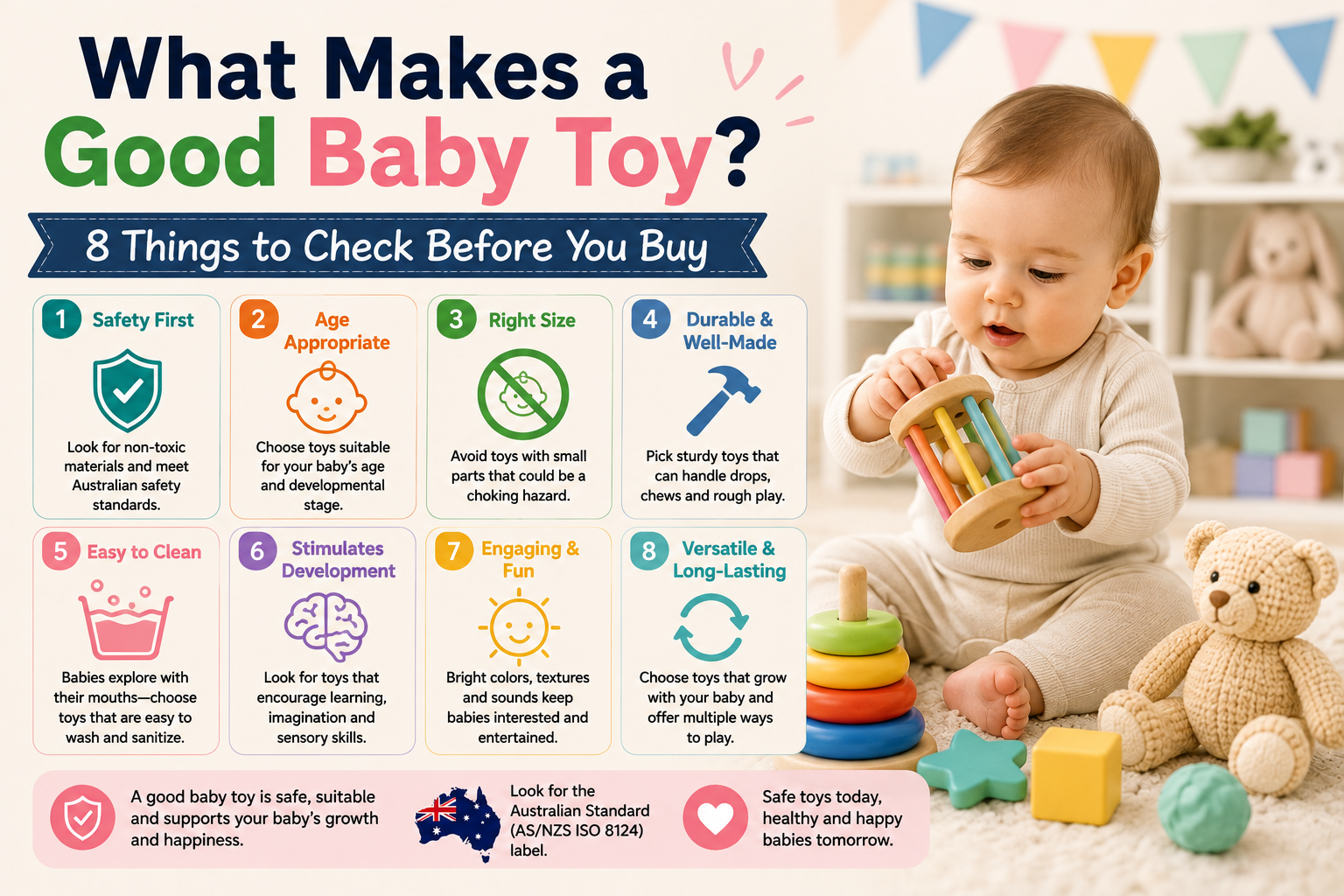
Quick answer: A good baby toy passes eight checks: it is the right size for choking safety, made from non-toxic material, fully washable, appropriately quiet, durable under real use, suited to your child’s current skill rather than a future one, open-ended rather than single-purpose, and compliant with Australian toy standards. If a toy fails any one of these, skip it regardless of price or reviews.
Key takeaways
- Size is the check that matters most under three. If it fits through a toilet roll tube, nothing else about the toy matters.
- “Educational” is an unregulated marketing word. It has no bearing on any of the eight checks.
- Open-ended toys pass the value test better than closed-ended ones. No correct outcome means no point at which the toy is finished.
- Price correlates weakly with quality. Several checks below cost nothing to verify and several expensive toys fail them anyway.
- A toy that fails the noise check can often be fixed, not just avoided worth knowing before you return a gift.
Toy shopping produces a strange kind of decision fatigue. Hundreds of products, all claiming to be good for development, most of the packaging telling you nothing useful about whether the toy in your hand is actually well made.
This guide sets out the eight checks worth running on any baby or toddler toy, regardless of age or price point. It applies across our whole baby toys by age guide every age-specific post in that guide links back to this one rather than repeating these checks.
1. Size: the choking test
The single most important check for any child under three, and the one to run before any other consideration.
The test: if the toy, or any part that could come loose, fits through a standard toilet roll tube, it is a choking hazard for a child under three. Run this at home, on the actual product, not from the packaging description.
This applies to:
- The whole toy, if it is small
- Any detachable part wheels, eyes, buttons, magnets
- Anything a toy comes packaged with small accessories, spare parts, decorative elements
A toy that passes for your child may not pass for your household. If a younger or older sibling shares the space, the smallest child’s safety needs govern what stays accessible.
Full detail and the mechanics of why this test works: choking hazards and the small parts test.
2. Material: what it is actually made of
Everything under about three gets mouthed, so material safety is not a minor consideration.
Look for:
- Food-grade silicone the standard for teethers and anything meant for the mouth
- Untreated or food-safe-finished hardwood — check the finish specifically, not just “wood”
- BPA-free, phthalate-free plastics — should be stated on packaging for anything marketed at babies
Be wary of:
- Painted wood where the paint could be chewed off — check the finish is food-safe, not just decorative
- Strong chemical smell straight out of the packaging — a genuine warning sign, not just an odd first impression
- Unbranded or unlabelled imports with no material information at all
Certifications worth trusting are the ones tied to an actual mandatory or independently audited standard, not a badge printed by the manufacturer itself. If a product claims a certification, it should be verifiable against a public register, not just stated on the box.
Full detail on materials and toxin concerns: non-toxic baby toys: materials, paints and certifications.
3. Washability: can it actually be cleaned
A toy that cannot be properly cleaned will eventually be thrown out anyway, usually after an illness has moved through the toy box. Check this before buying, not after.
| Material | How it should clean | Red flag |
| Silicone, hard plastic | Warm soapy water, or dishwasher-safe | Painted surfaces that could wear off with washing |
| Fabric, plush | Machine washable, ideally on a normal cycle | “Spot clean only” on something meant to be mouthed |
| Wood | Wipe-clean only, never soaked | No stated cleaning method at all |
| Electronic | Wipeable exterior, battery compartment stays dry | Fabric-covered speakers that cannot be spot-cleaned |
If the packaging does not say how to clean it, assume the worst case and buy accordingly.
Full washing method by material: how to clean baby toys properly.
4. Noise: check it before it is in the house
The specification most parents forget to check in the shop, and the one most likely to cause a return.
Some electronic toys measure loud enough at close range to be a genuine hearing concern — and toddlers hold things close to their faces, which adults rarely do in the shop when testing volume from arm’s length.
Before buying anything with a speaker:
- Look for a volume switch, not just an on/off two-level switches are common and worth insisting on
- Test it at arm’s length, then imagine it 20 cm from an ear
- Check whether the battery compartment is screw-secured while you are at it
If a loud toy is already in the house a common gift scenario a strip of tape over the speaker holes reduces output noticeably without damaging the toy or requiring you to return a present.
5. Durability: will it survive real use
Reviews rarely tell you this, because most reviews are written in the first week.
What actually predicts durability:
- Single moulded pieces outlast anything with glued-on or sewn-on parts, which loosen with repeated washing and mouthing
- Simple mechanisms last longer than complex ones — a toy with fewer moving parts has fewer things to break
- Reputation for the specific product line, not just the brand — large toy companies make products across a huge quality range
A rough guide to expected lifespan by construction type:
| Construction | Typical lifespan under real use |
| Single-piece silicone or hard plastic | Years |
| Wooden with sealed finish | Years, if not soaked |
| Fabric with sewn parts | Months to a year, depending on wash frequency |
| Glued components, water-filled items | Weeks to months |
| Battery-powered with speakers | Until the battery compartment or speaker fails |
6. Skill fit: right now, not next month
The most common buying mistake, and the one with the least obvious cost.
A toy bought for the stage after the current one usually gets ignored until the child grows into it — by which point it may already be forgotten, or a better option has appeared.
The check: does this toy match what your child is doing right now, not what they will be doing in three months? A toy pitched slightly above current ability is fine and often useful. A toy pitched a whole stage ahead sits unused.
Age labels on packaging complicate this, because they are usually safety ratings, not development ratings — “3+” almost always means small parts, not that the toy is too advanced for a younger child in a supervised setting where small parts are not a risk.
7. Open-ended vs single-purpose
This one distinction predicts long-term play value better than age, price or brand.
A closed-ended toy has one correct outcome. A shape sorter is solved when the shapes go in. A puzzle is finished when it is complete. Once mastered, interest drops sharply.
An open-ended toy has no correct outcome. Blocks, playdough, dolls, a play kitchen. There is nothing to finish, so there is nothing to outgrow.
Both have a place — closed-ended toys teach specific skills efficiently, and are worth buying cheaply and often. But the open-ended half of any toy collection is what gets used for years, and it is where the larger part of any budget is worth going.
8. Australian compliance
The check that is easiest to skip and the one with real legal weight behind it.
What to verify:
- The toy is compliant with the relevant Australian mandatory standard (AS/NZS ISO 8124 for most toys)
- Battery compartments are screw-secured, as required under Australian rules
- The product has not been the subject of a recall
Products sold overseas are not automatically compliant here. This matters particularly for items bought through international marketplaces, where a toy legally sold in another country may not meet Australian requirements.
The ACCC administers mandatory toy standards through Product Safety Australia, and maintains the official recall list. Checking a product against it takes a couple of minutes and is worth doing for anything secondhand or unfamiliar.
Full standards breakdown and a printable checklist: baby toy safety in Australia.
The eight checks as a quick-reference table
| # | Check | Fails if |
| 1 | Size | Fits through a toilet roll tube (under 3) |
| 2 | Material | No safety information, strong chemical smell, unverifiable claims |
| 3 | Washability | No stated cleaning method, or method is unrealistic for how the toy is used |
| 4 | Noise | No volume control, loud at close range |
| 5 | Durability | Glued parts, complex mechanisms, water-filled |
| 6 | Skill fit | Pitched a full stage ahead of current ability |
| 7 | Open-ended | Solved once, then abandoned |
| 8 | Compliance | Not verifiable against Australian standards, or subject to a recall |
A toy does not need to score perfectly on every check to be worth buying a single-purpose puzzle is fine as one item among several. But it should not fail any of them. A cheap toy that fails the size or material check is not a bargain.
Applying this to a specific age
These eight checks apply at every stage, but what “passes” looks different depending on your child’s age. Our age-by-age guides apply them directly:
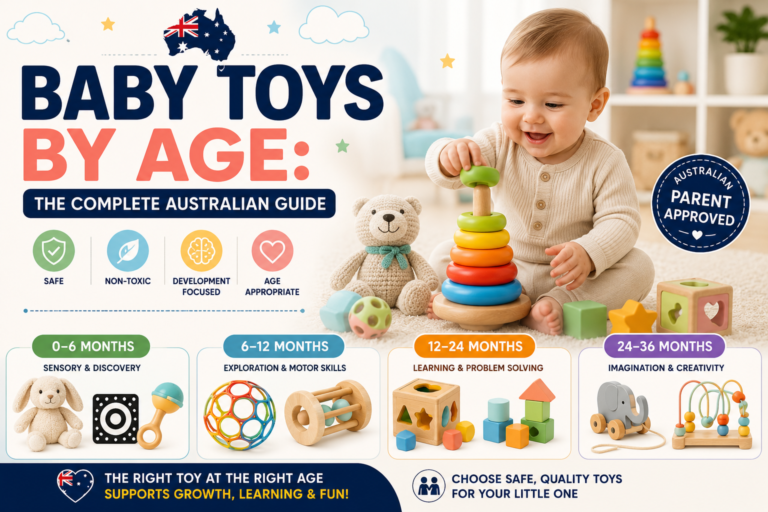
- Baby toys by age: the complete Australian guide
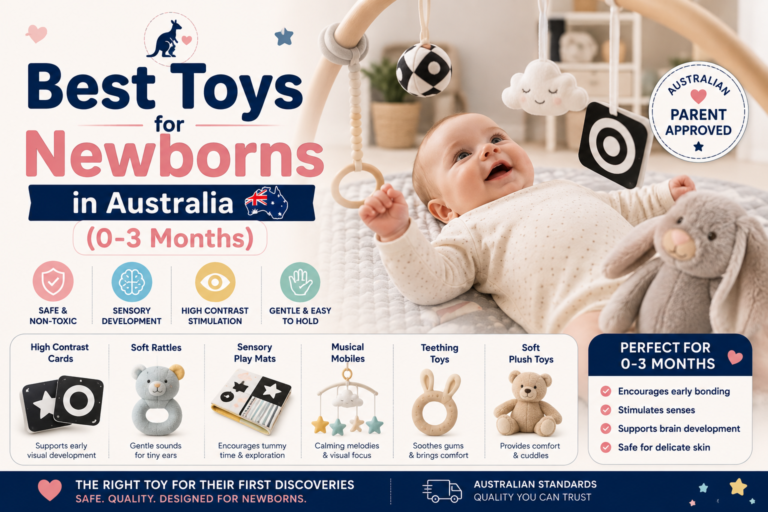
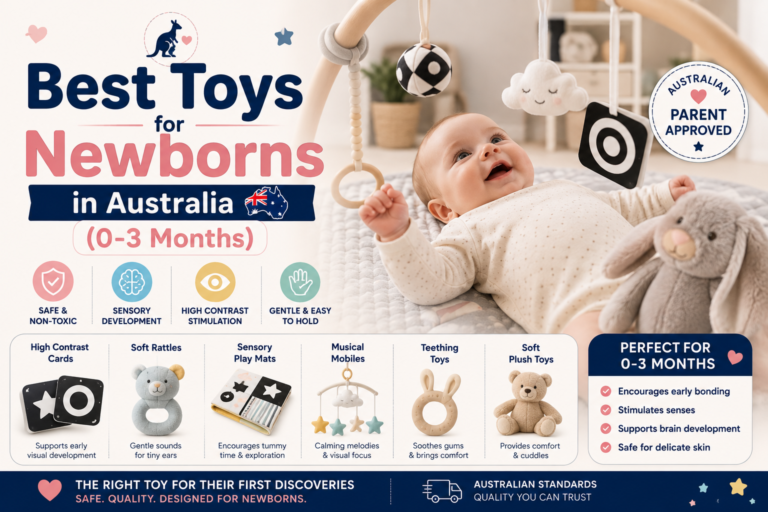
- Best toys for newborns in Australia
- Best toddler toys in Australia (12–36 months)
If you are buying a gift and want a shortlist rather than a framework, see first birthday gift ideas: 25 toys that get played with.
Frequently asked questions
What should I look for when buying a baby toy?
Eight things: correct size for choking safety, non-toxic material, full washability, appropriate noise level, durable construction, a fit with your child’s current skill level, open-ended rather than single-purpose design, and compliance with Australian toy standards.
Does “educational” mean a toy is actually good?
Not reliably. “Educational” is an unregulated marketing term with no fixed meaning in toy labelling. A simple set of stacking cups can build more skills than a toy carrying the label.
How do I know if a toy is a choking hazard?
Run the toilet roll test: if the toy, or any part that could come loose, fits through a standard toilet roll tube, it is a choking hazard for a child under three.
Are expensive toys better made than cheap ones?
Not consistently. Several of the eight checks size, washability instructions, noise controls — cost nothing to verify and have no relationship to price. Construction quality (single-moulded pieces versus glued parts) matters more than the price tag.
What does the age label on a toy actually mean?
It is almost always a safety rating rather than a development rating. “3+” usually indicates small parts that pose a choking risk to younger children, not that the toy is too advanced for them.
Is a loud toy safe if my baby doesn’t seem bothered?
Not bothered is not the same as safe. Some toys reach volumes that are a hearing concern at the close range babies hold things. Check for a volume control before buying, and cover the speaker with tape if a loud toy is already in the house.
How we choose the toys we recommend
Every recommendation on this site is run through these same eight checks before it appears in any age guide: Australian safety standards, material safety, washability, noise, durability, developmental fit, open-ended play value, and compliance verification. We prioritise products actually available to buy in Australia. Affiliate links, where used, are disclosed at the top of the article and do not affect ranking or which checks a product passes.
Sources referenced: Product Safety Australia (ACCC) for mandatory toy standards, material safety and recalls; Kidsafe Australia for general toy and nursery safety guidance.