How Many Toys Does a Baby Need? A Simple Guide for Australian Parents
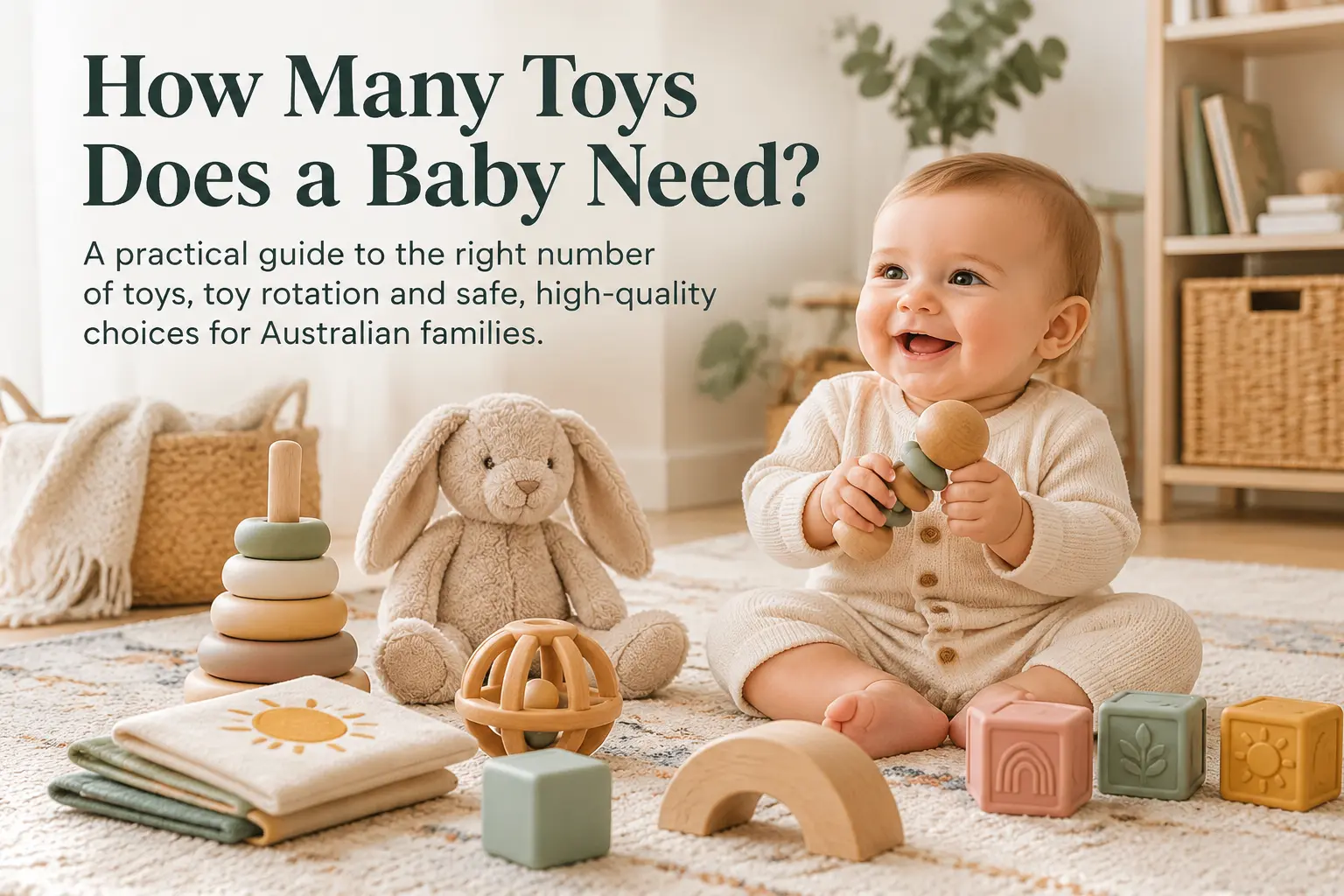
How many toys does a baby need? Most babies can enjoy play with a small collection of around 5–10 carefully chosen toys available at a time, rather than a room full of playthings. This is a practical starting point, not a developmental requirement. The right number depends on your baby’s age, interests, abilities and the toys already available at home.
Australian parents can keep things simple by choosing versatile, age-appropriate toys, rotating them when interest fades and using everyday interactions to make play enjoyable. This guide explains how to build a useful toy collection, which items to prioritise at each stage and how to choose safe materials without overspending.
Key Takeaways
- A small selection of 5–10 toys available at a time is a practical starting point, not a scientifically established ideal.
- Newborns benefit from interaction, gentle sounds, faces and a few simple toys.
- Toy rotation can refresh playtime without requiring constant purchases.
- Minimalist baby toys should offer useful ways to explore, grasp, look, listen or move.
- BPA-free labels alone do not guarantee that a toy is safe for a baby.
- Australian parents should check age recommendations, product condition, choking risks and applicable safety requirements before buying toys.
How Many Toys Does a Baby Need at Different Ages?
Babies do not need a fixed number of toys to develop well. A useful starting point is to keep around 3–5 suitable items available for a newborn and gradually increase the selection to around 5–10 as your baby becomes more mobile and interested in exploring objects.
These numbers are practical household suggestions, not official recommendations from Australian health authorities. Your baby might enjoy fewer toys, or benefit from a slightly larger selection if you have different play areas at home.
| Baby’s age | Suggested toys available at once | What to prioritise |
|---|---|---|
| 0–3 months | 3–5 | High-contrast visuals, soft voices, simple rattles and supervised tummy-time activities |
| 3–6 months | 4–6 | Easy-to-grasp toys, teethers, baby-safe mirrors and play-gym activities |
| 6–9 months | 5–8 | Stacking cups, sturdy board books, textured toys and suitable balls |
| 9–12 months | 6–10 | Large stacking toys, simple cause-and-effect toys, books and objects for supervised exploration |
Count individual toys rather than every piece in a set. For example, a stacking-cup set can count as one activity, although you should still inspect each cup for damage and suitability.
The purpose is not to meet a quota. Instead, aim for enough variety to offer different experiences without overwhelming your living space or spending money on toys your baby rarely uses.
What Are the Essential Toys for a Newborn?
Newborns need very few purchased toys because they spend much of their time feeding, sleeping and adjusting to the world around them. A few simple, age-appropriate items can support early visual exploration and interaction, but your face, voice and touch are also valuable parts of play.
Start with these options:
- High-contrast cards or pictures: Give your baby simple visual patterns to look at while awake and supervised.
- A lightweight baby rattle: Choose one designed for newborns, with no detachable parts or accessible small components.
- A suitable play mat: Create a clean, firm surface for supervised floor play and tummy time while your baby is awake.
- A sturdy baby book: Look for simple illustrations and materials suitable for the intended age.
- A securely made soft toy: Use it only for supervised play and keep it out of the baby’s sleep space.
You do not need to purchase all five immediately. Start with one or two suitable items, then add another if you find it useful.
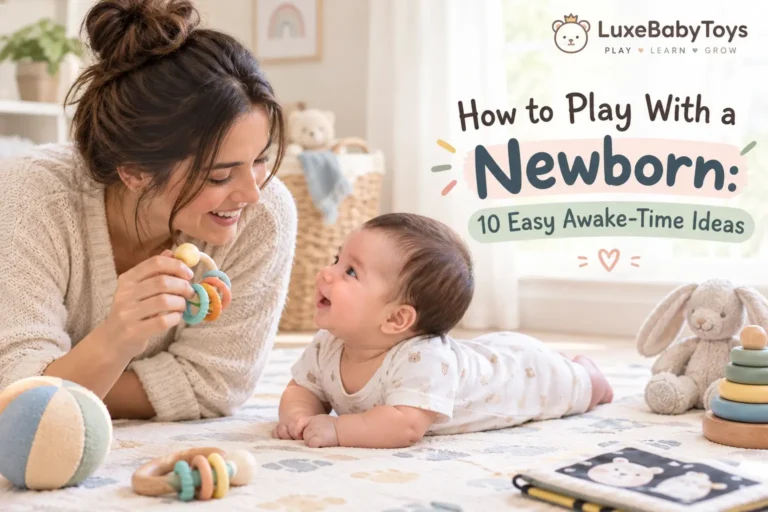
For more practical ideas, read our guide to how to play with a newborn. It covers simple awake-time activities that do not require a large toy collection.
Remember that newborn play should follow your baby’s cues. If your baby looks away, becomes unsettled or appears tired, pause the activity rather than introducing another toy.
Which Toys Does a Baby Need Between 3 and 6 Months?
Babies aged 3–6 months often become more interested in reaching, grasping, tracking movement and exploring objects with their hands and mouths. A small collection of around 4–6 suitable toys gives parents several ways to support these emerging skills.
Consider including:
- A lightweight rattle that is easy to grasp.
- A suitable teether for supervised use.
- A baby-safe mirror designed for infant use.
- A play gym with securely attached components.
- A washable textured toy or fabric book.
- One additional toy that encourages looking, reaching or gentle movement.
You can change how you use the same toy as your baby develops. For example, a rattle might initially attract attention through sound. Later, your baby may reach for it, grasp it and explore its shape.
This is one reason to avoid buying a new product for every developmental stage. A well-chosen toy can offer different experiences as your baby’s abilities change, provided it remains appropriate and safe.
Explore our guide to the best toys for babies aged 3–6 months for more age-specific ideas.
How Many Toys Does a Baby Need Between 6 and 12 Months?
Babies aged 6–12 months often benefit from a wider range of toys because they may begin sitting, transferring objects between their hands, crawling and investigating how things work. Around 5–10 toys available at once is a reasonable starting point for organising play, although the exact number matters less than suitability and variety.
Useful options include:
- Stacking cups: Offer opportunities to grasp, stack, nest and explore different sizes.
- Sturdy board books: Encourage looking, listening and shared reading.
- Suitable soft balls: Provide opportunities for reaching, rolling and movement.
- Textured toys: Offer different tactile experiences.
- Simple cause-and-effect toys: Let babies explore what happens when they push, pull or move an object.
- Large, age-appropriate stacking toys: Encourage object handling and simple problem-solving.
Choose toys based on what your baby can safely explore now, not what a product promises they will learn later.
As babies become more mobile, inspect the surrounding play area as carefully as the toys. Items that were previously out of reach may become accessible once a baby starts crawling or pulling up.
Does a Baby Need Expensive Educational Toys?
No. Babies do not need expensive educational toys to explore movement, sound, touch or communication. Simple objects designed for infant use, board books, supervised floor play and responsive interaction can provide a wide range of play experiences.
A toy’s price does not tell you how useful it will be. A complicated electronic toy may offer only one type of interaction, while a simple stacking toy can be used in several ways as a baby grows.
Consider these examples:
| Toy or activity | Potential play value | What to consider |
|---|---|---|
| Board book | Looking at pictures and listening to words | Choose sturdy, age-appropriate books |
| Lightweight rattle | Exploring sound and grasping | Check construction and small-part risks |
| Stacking cups | Handling objects and exploring size | Check age suitability and durability |
| Baby-safe mirror | Looking and visual exploration | Use a product designed for infant use |
| Face-to-face interaction | Social connection and early communication | No purchase required |
Before buying another toy, ask whether it offers an experience your baby does not already have. If it duplicates several toys you own, you may get more value from rotating the existing collection.
This approach can also help families set a budget and reduce clutter without treating every purchase as an investment in future development.
What Is Toy Rotation, and How Does It Work?
Toy rotation is a simple way to manage a baby’s toys by keeping a small selection available and storing the rest temporarily. Parents then swap a few items when the baby loses interest, the toys no longer suit their abilities or the family wants to offer a different play experience.
Toy rotation does not require a strict schedule or prove that babies learn more than they would with other arrangements. It is a practical organisation method that can help families reuse toys and keep play spaces manageable.
How to rotate baby toys in five steps
- Collect the toys. Gather the age-appropriate toys your baby currently uses and inspect each one for damage.
- Choose a small selection. Keep a few different options available, such as a book, a grasping toy and a suitable sensory toy.
- Store the rest safely. Use a closed storage area that your baby cannot access independently.
- Watch your baby’s interest. Look for signs that your baby enjoys a toy, ignores it or needs a different level of challenge.
- Swap selected items. Reintroduce stored toys or change the selection when it makes sense for your baby’s needs.
For example, a six-month-old might have a rattle, a textured toy, a baby-safe mirror, a teether and a board book available during one period of play. Later, you could replace the mirror with another suitable grasping toy while keeping the book and rattle.
You do not need to rotate everything at once. Keep familiar favourites available when your baby enjoys them, and always check that stored toys remain clean and safe before reintroducing them.
How Often Should You Rotate Baby Toys?
There is no universally recommended toy-rotation schedule. For a practical starting point, review your baby’s toys every week or two, but make changes sooner if your baby loses interest or a toy no longer matches their abilities.
Use your baby’s behaviour rather than the calendar to decide when to switch.
- Keep a toy available if your baby regularly reaches for it or explores it in different ways.
- Try a different toy if your baby repeatedly ignores an item and seems interested in something new.
- Reintroduce a familiar toy after a break if you want to offer variety without buying another product.
- Remove a toy immediately if it becomes damaged, develops loose parts or presents a safety concern.
Repetition is normal during infancy. A baby may enjoy reaching for the same toy repeatedly because the action itself is interesting. You do not need to replace a toy simply because your baby has seen it several times.
Also, rotation should never interfere with your baby’s comfort or access to suitable play opportunities. It is a tool for organising toys, not a rule that requires you to remove something your baby enjoys.
Can Babies Learn With Fewer Toys?
Yes. Babies can explore a range of experiences with a small collection of suitable toys and responsive interaction. They do not need a new product for every skill or activity.
A smaller collection can make it easier for parents to notice which objects interest their baby. It also means fewer items to clean, store and inspect for wear.
Consider a stacking-cup set. A younger baby might grasp one cup or explore its surface. An older baby may enjoy nesting the cups, knocking down a stack or watching an adult demonstrate how they fit together. The same item can support different types of play over time.
However, fewer toys should not mean fewer opportunities to move, explore or interact. Babies also benefit from supervised floor time, familiar voices, books and age-appropriate everyday activities.
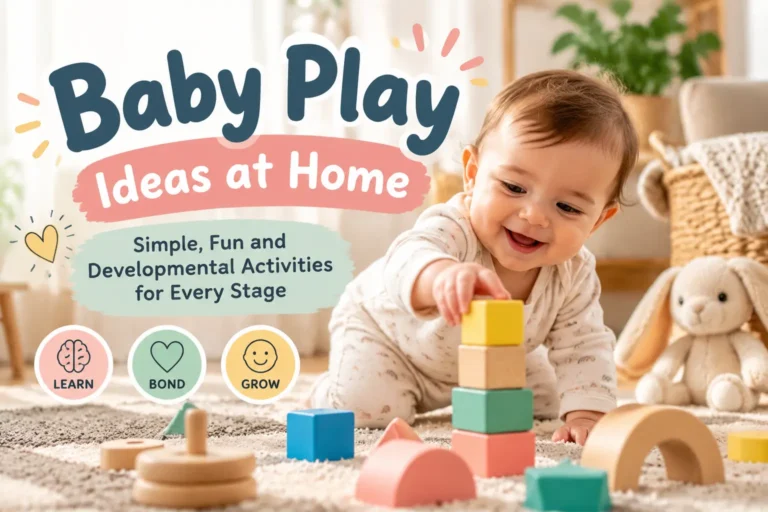
Our guide to baby play ideas at home offers practical activities that combine movement, communication and sensory exploration without requiring a large collection of equipment.
The goal is to create a safe, engaging environment, not to achieve the smallest possible number of toys.
What Are Minimalist Baby Toys, and Which Ones Are Worth Buying?
Minimalist baby toys are a small selection of relatively simple playthings chosen for their usefulness, age suitability and potential to offer different kinds of exploration. They can help parents reduce clutter and avoid buying toys that serve almost identical purposes.
A minimalist collection does not have to follow a particular aesthetic. Bright colours, textured surfaces and different shapes can all be useful when they suit the baby’s stage and the product is safe.
Prioritise toys that offer one or more of these experiences:
- Grasping: Lightweight toys designed for little hands.
- Visual exploration: High-contrast pictures or suitable mirrors.
- Sensory exploration: Toys with safe textures and simple sounds.
- Movement: Suitable balls or toys that encourage reaching.
- Early problem-solving: Stacking cups and simple, age-appropriate cause-and-effect toys.
- Language and interaction: Sturdy baby books and shared reading activities.
You do not need one toy from every category at all times. Choose based on your baby’s current interests and the toys you already own.
A simple minimalist baby toy checklist
Before adding a product to your collection, ask:
- Does my baby have the skills to use it safely?
- Does it offer something different from our current toys?
- Can I clean and maintain it according to the manufacturer’s instructions?
- Is it sturdy enough for the way babies explore objects?
- Do I have space to store it safely?
If a product does not fill a genuine need, leave it off your shopping list. You can always reassess as your baby grows.
How Can You Choose BPA-Free Baby Toys and Safe Toy Materials?
Parents should check material information, construction and age suitability rather than relying on a single marketing label. BPA-free baby toys can be one consideration, but the label alone does not establish that a complete product is safe for infant use.
BPA, or bisphenol A, is a chemical used in the production of certain plastics and resins. Parents looking to limit BPA exposure may prefer clearly labelled products with reliable material information. However, a BPA-free claim does not confirm that a toy has no other potentially harmful substances or physical hazards.
Which materials should parents consider?
| Material or product type | What to check before buying |
|---|---|
| Silicone | Look for clear material information, appropriate age guidance and cleaning instructions |
| Plastic | Check construction, age suitability and any relevant material disclosures |
| Natural wood | Check for smooth surfaces, secure construction and suitable non-toxic finishes |
| Fabric | Check stitching, fibre shedding, washable care instructions and securely attached components |
| Painted or coated toys | Look for appropriate safety information and non-toxic paints or finishes |
No material is automatically safe in every product. A wooden toy can splinter, fabric can tear and plastic can crack. Silicone products can also become damaged, so inspect them regularly.
The Australian Competition and Consumer Commission (ACCC) advises parents to choose sturdy, age-appropriate toys and remove products that are broken, brittle, tearing or falling apart. Its official kids’ toys safety guide provides further buying and maintenance advice.
What Australian toy safety requirements should you know?
Australia has a mandatory safety standard for toys intended for children up to and including 36 months. It addresses design, construction and testing, including the risk of small parts coming loose and causing choking or other injuries.
The ACCC also explains that toys for this age group must meet applicable requirements, and certain battery-operated toys must have secure battery compartments. Parents can review the mandatory standard for toys up to 36 months for further information.
Before purchasing, check the recommended age, warning labels and product details. Avoid toys with loose small parts, sharp edges or accessible button batteries. Also keep toys for older children away from babies, even when the older child’s toys appear well made.
Safety comes before toy quantity, price or appearance.
How Can You Reduce Baby Toy Clutter Without Buying More?
You can reduce toy clutter by using what you already own, storing toys safely and buying replacements only when there is a genuine need. Start by sorting your baby’s toys into three groups: regularly used, suitable for rotation and ready to be removed.
First, remove damaged toys and check whether any items are no longer age-appropriate. Next, keep a small selection in the main play area and store suitable extras out of reach. Finally, review the collection when your baby’s interests or abilities change.
You can also reduce unnecessary purchases in several ways:
- Ask family members to consider a useful toy rather than several small gifts.
- Choose versatile toys that offer more than one type of play.
- Borrow or buy second-hand toys only after checking their condition, age suitability and recall status.
- Avoid buying toys simply because another baby has them.
- Use books, songs, supervised movement and interaction to add variety.
Second-hand products need particular care. Check for missing instructions, damage, loose components and product recalls before allowing your baby to use them.
A tidy play area does not need to be empty. It simply needs enough suitable options for your baby to explore safely, with space to move and interact with you.
When Should You Buy More Toys for Your Baby?
Buy another toy when your current collection no longer offers suitable options for your baby’s interests or emerging abilities. You do not need to buy toys at every milestone, birthday or age change.
For example, a baby who has started sitting may enjoy a suitable stacking toy, while a crawling baby may benefit from more space for movement and supervised exploration. Before making a purchase, check whether a toy you already own can offer a similar experience.
A useful buying decision comes down to three questions:
- Is it age-appropriate? Check the manufacturer’s guidance and your baby’s current abilities.
- Does it add something useful? Consider whether it offers a different experience from existing toys.
- Is it safe and practical? Review construction, materials, cleaning requirements and storage needs.
Some babies enjoy exploring objects for longer periods, while others prefer interaction with a caregiver. Both preferences are normal. Your collection should suit your baby rather than a shopping checklist.
If you are unsure about your baby’s development or the activities suitable for their needs, speak with your child and family health nurse or another qualified health professional.
Frequently Asked Questions
1. How many toys should a baby have at once?
Around 5–10 toys available at a time is a practical starting point for many families. Newborns may need fewer. This is a household organisation suggestion, not an official developmental recommendation, so adjust the number to your baby’s interests and available space.
2. Is it better to buy fewer toys for a baby?
A smaller collection can reduce clutter and make it easier to organise play. However, fewer toys are not automatically better for development. Choose a useful range of safe, age-appropriate options and include interaction, movement and reading in your baby’s routine.
3. How often should I rotate my baby’s toys?
Review your baby’s collection every week or two as a starting point, or sooner if their interests change. There is no required rotation interval. Keep familiar favourites available and remove any damaged or unsuitable toys immediately.
4. Are BPA-free baby toys always safe?
No. BPA-free describes a particular chemical claim, not the overall safety of a toy. Parents should also check product construction, age recommendations, choking hazards, material disclosures and applicable Australian safety requirements.
5. What toys does a newborn actually need?
A newborn can begin with a few suitable items, such as a simple visual toy, a baby-safe rattle and a sturdy book. Face-to-face interaction, talking and singing are also valuable. Always supervise play and keep toys out of the baby’s sleep space.
6. Can everyday household items replace baby toys?
Some everyday activities can complement a baby’s toy collection, but not every household object is safe. Use suitable, clean objects only under close supervision, and avoid small items, plastic bags, cords, sharp edges and anything that can break into dangerous pieces.
7. When should I replace my baby’s toys?
Replace a toy when it becomes damaged, brittle, cracked, torn or unsafe for your baby’s developmental stage. You do not need to replace a toy simply because your baby has grown older if it remains appropriate, intact and safe to use.
How Many Toys Does a Baby Need? Keep It Simple
So, how many toys does a baby need? Start with a small, practical collection, choose items suited to your baby’s current abilities and add more only when they offer a genuine benefit. A few well-chosen toys, regular opportunities for supervised play and time with a responsive caregiver can provide plenty of variety without filling your home with unnecessary purchases.
Toy rotation can help you reuse toys and keep the play area manageable. At the same time, careful attention to age recommendations, product condition and material information helps you make safer choices.
If you are building your baby’s first collection, explore Luxe Baby Toys for age-appropriate options. Choose carefully, follow product safety instructions and let your baby’s interests guide your next purchase.