Best Educational Toys for One Year Olds: An Australian Guide
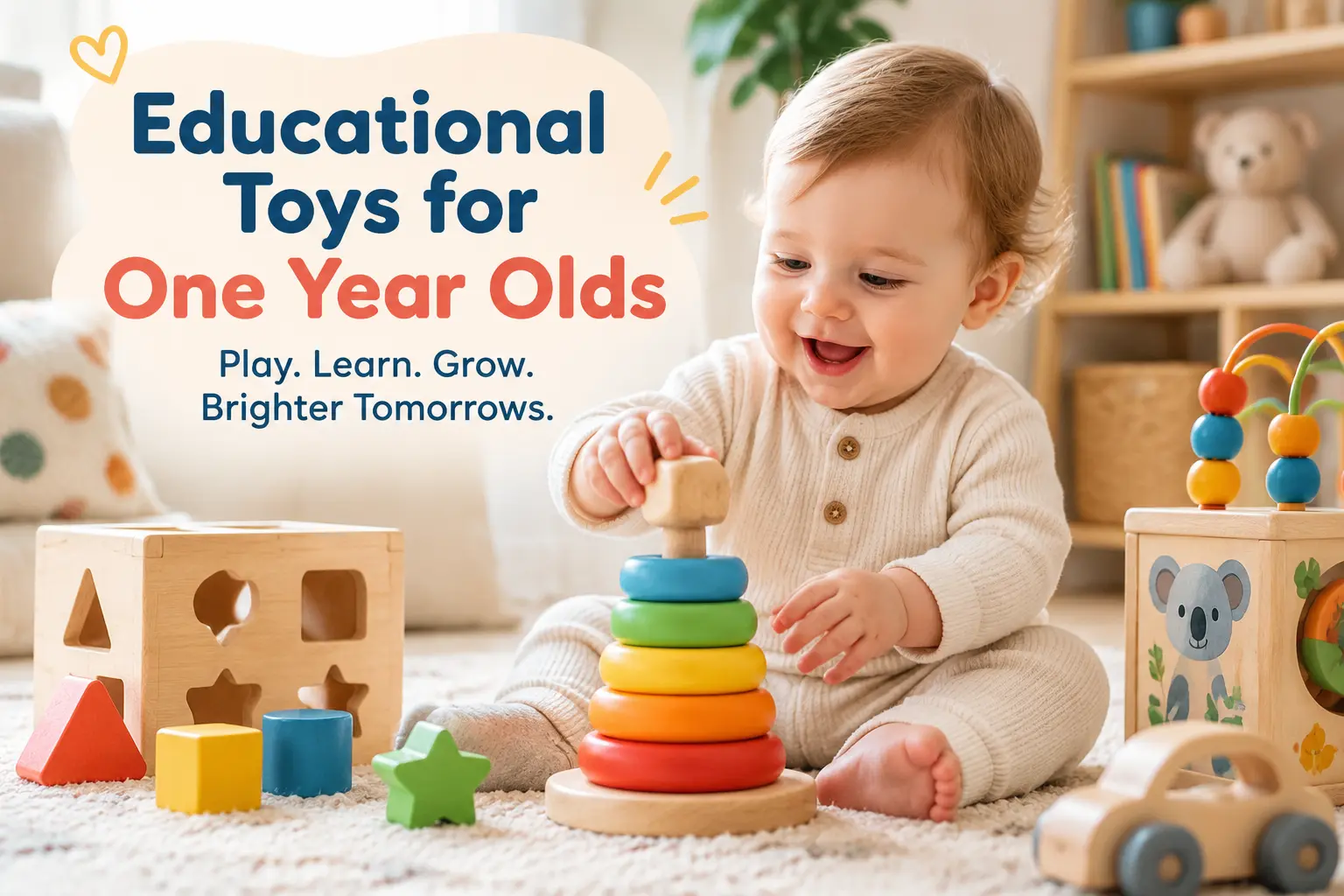
The best educational toys for one year olds encourage babies to explore, stack, sort, move, listen and copy everyday actions. Simple toys such as stacking cups, shape sorters, chunky puzzles, board books and large building blocks support early learning without complicated instructions or screens.
At around 12 months, children develop new ways to use their hands, understand objects and communicate with adults. However, every child develops at their own pace. Choosing toys that match your child’s current abilities makes play more enjoyable and gives them opportunities to practise new skills.
This guide explains which toys to choose, what children can learn from them, how much Australian parents might spend and which safety checks matter before buying a new toy.
Key Takeaways
- Stacking cups and large blocks encourage hand-eye coordination, problem-solving and early spatial awareness.
- Simple shape sorters and chunky puzzles introduce matching, trial and error, and object recognition.
- Board books, songs and pretend-play toys support communication, listening and imitation.
- Open-ended toys offer different ways to play as your child’s abilities develop.
- Age suitability and toy safety matter more than a toy’s price or the number of features it offers.
- Parents can support learning through everyday interaction, including naming objects, demonstrating actions and allowing children time to explore.
What Are the Best Educational Toys for One Year Olds?
The best educational toys for one year olds are safe, easy to handle and suited to the skills your child is practising. Stacking cups, large blocks, simple puzzles, sensory balls, board books and basic musical toys are useful starting points because children can explore them in different ways.
Educational toys are play materials designed to encourage skills such as movement, communication, sensory exploration, problem-solving and early understanding of the world.
A toy does not need flashing lights, recorded instructions or a complicated learning system to be educational. A toddler who repeatedly fills a cup, empties it and fills it again is exploring how objects fit together and what happens after each action.
Choose toys that allow your child to participate actively. For example, a shape sorter gives your toddler the opportunity to pick up a shape, turn it, try an opening and adjust their approach. An electronic toy that performs the same action automatically may offer fewer opportunities for this kind of hands-on exploration.
For more age-specific recommendations, explore Luxe Baby Toys’ guide to the best toys for one-year-olds in Australia.
Which Types of Toys Help a One-Year-Old Learn Best?
Different toys encourage different skills, so a small, varied collection is often more useful than buying several toys that all do the same thing. Combining movement toys, books, building toys and sensory activities gives children different ways to explore.
| Toy type | Skills it encourages | How to use it |
|---|---|---|
| Stacking cups | Coordination, size awareness and problem-solving | Stack, nest, fill and empty the cups |
| Shape sorters | Matching, spatial awareness and trial and error | Demonstrate how one shape fits |
| Large building blocks | Grasping, coordination and spatial exploration | Build a short tower and knock it down |
| Chunky board books | Listening, early language and attention | Name pictures and describe actions |
| Sensory balls | Touch, grasping and movement | Roll the ball between you |
| Simple musical toys | Listening, rhythm and cause and effect | Tap, shake and pause for your child |
| Pretend-play toys | Imitation and early communication | Pretend to talk on a toy phone |
| Stable push-along toys | Standing, balance and movement practice | Let your child push on a clear, safe surface |
These categories work best when adults let children explore at their own pace. Demonstrate an action, offer encouragement and give your child time to respond instead of expecting them to copy every movement.
How Do Educational Toys Support Development at One Year Old?
Educational toys support development by giving children opportunities to practise physical, cognitive, sensory and communication skills during play. Their value comes from the actions children perform and the interaction they receive, not from a product label claiming to make them smarter.
Fine motor skills and hand-eye coordination
Fine motor skills involve small movements of the hands and fingers. Stacking cups, large blocks and simple posting toys encourage children to grasp objects, release them and guide them towards a target.
For example, your child might initially knock over a tower instead of adding another block. That is still an opportunity to explore movement, balance and the result of an action.
Cognitive development and problem-solving
Cause-and-effect toys help children discover that their actions produce results. A ball-drop toy, for example, lets a child release a ball and watch it move through a track.
Simple puzzles also encourage experimentation. A child can rotate a chunky puzzle piece, try another opening and gradually learn how the pieces fit.
Sensory exploration
Sensory toys introduce different textures, sounds, shapes and movements. Textured balls, fabric books and safe rattles allow children to explore these differences through touch, sight and hearing.
For more ideas, read the complete guide to sensory toys for Australian parents.
Early language and communication
Books, songs and pretend-play toys create opportunities for conversation. When you point to a picture and say “dog”, your child can connect the word with the image.
Pause after asking a simple question or naming an object. Your child might respond with a sound, gesture, facial expression or word.
The Australian parenting resource Raising Children Network also recommends varied, child-led play and interaction with adults as important parts of learning.
Which Toys Help One-Year-Olds Develop Fine Motor Skills?
Stacking cups, large blocks, chunky puzzles and simple shape sorters are useful choices for practising fine motor skills. These toys let children grasp, release, rotate and position objects while learning how their hands interact with the surrounding world.
Start with activities that are easy to attempt. Offer two or three large stacking cups rather than presenting a complicated construction set. Show your child how to place one cup inside another, then allow them to experiment.
Large blocks offer another simple activity. Place two blocks together and invite your toddler to add a third. If the tower falls, rebuild it and let your child try again.
Chunky puzzles with large, securely attached knobs can also encourage grasping and placement. Choose simple designs with only a few pieces, and avoid puzzles that contain small removable parts.
Parent tip: Look for toys that offer a manageable challenge. A toy that is too difficult can cause frustration, while a toy that is too simple may hold your child’s interest for less time. Adjust the activity before deciding your child needs a different toy.
Are Sensory Toys Good for One-Year-Olds?
Yes. Sensory toys can give one-year-olds opportunities to explore texture, sound, colour, movement and touch. Choose simple, washable products that suit your child’s interests, and avoid toys with detachable parts, accessible batteries or materials that can break into small pieces.
Useful options include textured balls, soft fabric books, sturdy rattles and appropriately designed stacking cups. Parents can also introduce supervised water play using a shallow container and a few large, safe cups.
However, sensory play does not require specialist equipment. A child can explore the feel of a clean, textured fabric book or listen to the sound of a large wooden block tapping against another.
Watch how your child responds. Some children enjoy rattles and musical toys, while others prefer quiet activities with books or blocks. You do not need to keep offering a toy that appears to overwhelm or upset your child.
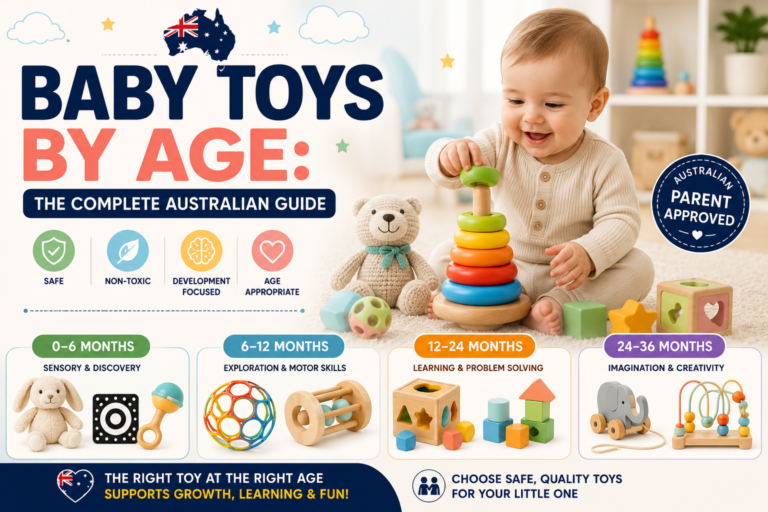
For a broader selection of age-related play ideas, see the Australian guide to baby toys by age.
Which Educational Toys Encourage Early Speech and Language?
Board books, toy telephones, animal toys and simple musical instruments can encourage early communication when adults use them during shared play. These toys give parents natural opportunities to name objects, repeat sounds, describe actions and respond to a child’s attempts to communicate.
Choose board books with clear pictures of familiar objects, animals, people and everyday activities. Point to one image at a time and use short phrases such as “big dog”, “blue car” or “baby sleeping”.
Pretend-play toys can also encourage imitation. For example, hand your child a toy telephone and pretend to say hello. Your toddler might respond by holding the toy to their ear or making a sound.
Musical toys provide another way to practise listening and turn-taking. Tap a drum once, pause and see whether your child responds with a tap of their own.
Remember that children communicate in different ways. Gestures, eye contact, facial expressions and sounds are all meaningful parts of early interaction. Toys can create opportunities for communication, but they do not guarantee that a child will reach a particular speech milestone.
If you have concerns about your child’s hearing, communication or development, speak with your child health nurse or GP.
Are Wooden Toys Better Than Electronic Learning Toys?
Wooden toys can offer durability and simple, open-ended play, while electronic toys may introduce sounds, lights and immediate responses. Neither material is automatically better. The best choice depends on the toy’s design, safety, usefulness and suitability for your child’s age.
| Feature | Wooden toys | Electronic toys |
|---|---|---|
| Learning opportunities | Often encourage hands-on exploration | Vary according to how actively children participate |
| Sensory feedback | Usually based on touch, movement and sound | May include lights, recorded sounds and movement |
| Maintenance | Check for splinters, loose parts and damaged finishes | Check wiring, casing and battery compartments |
| Play flexibility | Many designs support several activities | Some products focus on a limited set of functions |
| Buying consideration | Check finish quality and construction | Check volume, battery security and age suitability |
A wooden block set can become a tower, a line of objects or a pretend wall. An electronic toy may be useful if it invites children to press a button, repeat an action and explore the result. However, a toy that mainly entertains a child without encouraging interaction may not offer the same opportunities for active exploration.
Therefore, compare what your child can do with a toy rather than counting its features. A well-made, simple toy can offer plenty of learning opportunities without requiring batteries or a charging cable.
How Can Parents Teach Shapes, Colours and Numbers Through Play?
Parents can introduce early concepts by naming objects during ordinary play rather than expecting a one-year-old to memorise shapes, colours or numbers. Repetition, demonstrations and simple words help children become familiar with language while they explore.
Try these activities at home:
- Explore shapes: Offer a simple shape sorter and name a shape as your child handles it. Focus on exploring rather than expecting a correct answer.
- Compare sizes: Place two stacking cups together and say “big cup” and “little cup”.
- Count objects aloud: Count two large blocks as you place them on the floor. Your child does not need to repeat the numbers.
- Name colours: Describe a brightly coloured ball as you roll it back and forth.
- Match everyday objects: Show your child two identical cups or matching pictures in a board book.
Keep these activities brief and enjoyable. If your toddler loses interest, move on to another activity.
At this age, exposure matters more than formal teaching. Your child can become familiar with words and concepts long before they can name them consistently.
What Are the Best Educational Gifts for One-Year-Olds in Australia?
The best educational gifts for one-year-olds are practical, age-appropriate toys that encourage repeated play. Stacking cups, large blocks, board books, simple puzzles and stable push-along toys are useful options for birthdays, Christmas and other family occasions.
Your budget does not need to be large. Choose a toy that fits your child’s abilities and offers several ways to play.
| Gift idea | Why it makes a good gift | Indicative Australian budget |
|---|---|---|
| Stacking cups | Supports stacking, nesting and filling activities | AUD $5–$20 |
| Board book set | Encourages shared reading and vocabulary | AUD $15–$35 |
| Large building blocks | Supports construction and experimentation | AUD $20–$60 |
| Simple shape sorter | Introduces matching and problem-solving | AUD $15–$40 |
| Chunky puzzle | Encourages grasping and object placement | AUD $15–$30 |
| Sensory ball set | Offers tactile exploration and rolling games | AUD $10–$30 |
| Stable push-along toy | Encourages movement for children ready to use it | AUD $40–$100 |
<text color=”secondary” size=”sm”>These are indicative planning ranges, not verified live prices. Actual costs vary by retailer, brand, product quality and sale period.</text>
Before buying, check the recommended age, construction quality and cleaning instructions. Avoid gifts that include small accessories or parts intended for older children.
If you need more inspiration, browse Luxe Baby Toys’ first birthday gift ideas featuring 25 toy options. The guide can help you compare different types of gifts before deciding what suits your child.
How should you choose a gift for a child’s first birthday?
Start with the child’s current interests. A baby who enjoys putting objects into containers may enjoy stacking cups or a simple sorter. A child who loves looking at pictures may prefer a set of sturdy board books.
You can also ask parents whether they need a particular item. Practical gifts are often more useful than another toy that duplicates something the family already owns.
How Can You Choose Safe Educational Toys for a One-Year-Old?
Choose toys labelled for the correct age, made from sturdy materials and free from small parts that could detach during use. Australian product safety guidance recommends checking toys for damage, sharp edges, loose components and accessible button batteries before giving them to a young child.
Children at this age commonly explore objects with their mouths. That makes the size, construction and condition of a toy especially important.
The Australian Competition and Consumer Commission (ACCC) provides a kids’ toys safety guide with practical advice for families.
Check these points before buying:
- Age labelling: Follow the manufacturer’s age recommendation and warnings.
- Small parts: Avoid toys with small detachable components that could cause choking.
- Button batteries: Prefer toys without button batteries. If a toy uses them, verify that the battery compartment is securely fastened as required.
- Magnets: Avoid toys containing small, accessible magnets.
- Cords and strings: Keep long cords and loops away from young children.
- Material quality: Check for sharp edges, splinters, loose stitching and pieces that could break off.
- Cleaning: Choose products that can be cleaned according to the manufacturer’s instructions.
- Regular inspection: Stop using damaged toys immediately.
Button batteries deserve particular attention because swallowing one can cause severe internal injuries. Read the official Product Safety Australia button-battery guide before buying toys that contain them.
Always supervise your child during play. A toy’s age label does not remove the need to check its condition and use it as intended.
How Can You Make Educational Toys More Effective at Home?
You can make educational toys more useful by playing alongside your child, demonstrating simple actions and following their interests. Children do not need a formal lesson every time they play. Short, repeated interactions often fit naturally into everyday family routines.
Follow this simple process:
- Choose one activity. Offer a few stacking cups, a board book or a large ball.
- Demonstrate an action. Stack two cups, turn a page or roll the ball.
- Pause and observe. Give your child time to examine the toy and decide what to do.
- Describe what happens. Use short phrases such as “the ball rolls” or “the cup is inside”.
- Let your child experiment. Allow them to repeat the activity or try a different approach.
- Change the activity when needed. If your child becomes tired or frustrated, simplify the task or take a break.
For example, during stacking play, you can place one cup inside another and describe the action. Your child might copy you, knock the cups over or use them in a completely different way. Each response gives you an opportunity to interact and follow their curiosity.
Which everyday household items can support learning?
Safe household objects can complement purpose-made toys. Large plastic containers, sturdy cardboard books and unbreakable bowls may encourage exploration when used appropriately and under close supervision.
Check every item before play. Avoid objects that can splinter, break, trap fingers or contain small detachable pieces. Never give a one-year-old loose coins, buttons, uncooked food pieces or other small objects as learning materials.
Water play requires continuous adult supervision. Keep your child within arm’s reach around any water, even in a shallow container.
How Many Educational Toys Does a One-Year-Old Need?
A one-year-old does not need a large toy collection to learn through play. A small selection of varied, age-appropriate toys can provide opportunities for movement, sensory exploration, language and problem-solving without overwhelming the play area.
Start with a few different categories:
- One or two stacking or building toys.
- A simple puzzle or shape sorter.
- Two or three sturdy books.
- A safe ball or sensory toy.
- A suitable pretend-play or musical toy.
You can rotate toys when your child’s interests change. Store unused toys safely and bring them back later, provided they remain appropriate for your child’s age and abilities.
However, there is no universal number of toys that guarantees better learning. Some children prefer repeating one activity, while others move between several toys. Follow your child’s interests rather than buying more items simply to keep them entertained.
Parents should also remember that play does not always require a product. Talking, singing, looking at books together and exploring safe spaces provide valuable opportunities for interaction.
Which Educational Toys Should Parents Avoid for One-Year-Olds?
Avoid toys that are too complex, poorly constructed or unsuitable for your child’s current abilities. Toys with small detachable pieces, accessible batteries, strong magnets or long cords can create serious hazards, while overly complicated activities may lead to frustration.
Consider these common buying mistakes:
- Choosing toys for older children: A toy marked for ages three and above may contain parts unsuitable for a one-year-old.
- Buying oversized learning systems: Large electronic toys can take up space without offering the kind of hands-on play your child enjoys.
- Prioritising lights and sounds: More stimulation does not automatically mean more learning.
- Ignoring maintenance: Cracked plastic, loose components and damaged seams can turn a previously safe toy into a hazard.
- Expecting immediate results: Children learn through repetition, and they may use a toy differently from what the manufacturer intended.
You do not need to avoid every electronic toy or choose only wooden products. Instead, assess each product for safety, active participation and developmental suitability.
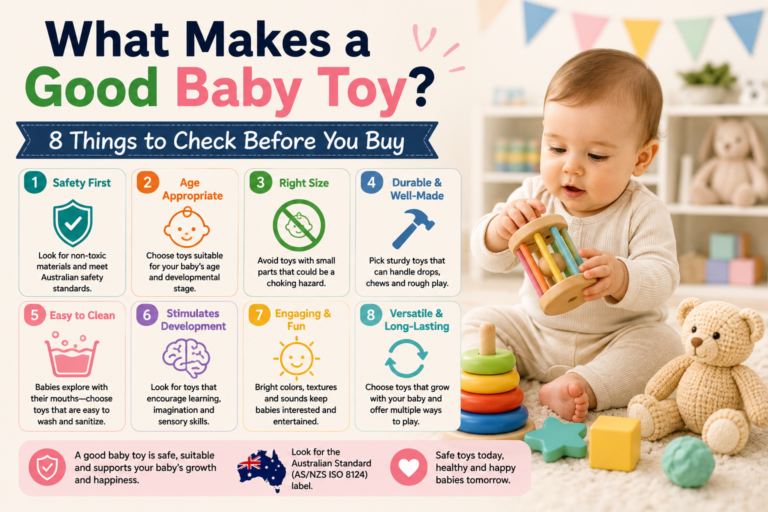
For additional buying criteria, read What Makes a Good Baby Toy? Eight Things to Check Before You Buy.
Frequently Asked Questions About Educational Toys for One-Year-Olds
1. What is the best educational toy for a one-year-old?
Stacking cups are a useful starting point because children can stack them, nest them, fill them and empty them. A simple shape sorter, chunky puzzle or board book can also work well. Choose according to your child’s current interests and abilities.
2. Are educational toys necessary for a one-year-old?
Specialist educational toys are not necessary for learning. Safe everyday objects, shared reading, singing and interactive play can provide valuable opportunities to explore movement, language and problem-solving. Purpose-made toys simply offer additional ways to support these activities.
3. What are the best learning educational toys for a 12-month-old?
Useful options include large stacking cups, chunky blocks, simple shape sorters, board books and sensory balls. These toys encourage grasping, exploration and interaction. Choose age-appropriate products with no small detachable parts and allow your child to explore without expecting them to master every activity.
4. Are wooden educational toys safe for one-year-olds?
Wooden toys can be suitable when they are designed for the child’s age, have smooth edges and contain no loose or detachable parts. Inspect the finish for splinters, cracks and peeling paint. Wooden construction alone does not guarantee safety, so check the product’s labelling and condition.
5. What are affordable educational gifts for 1 year olds in Australia?
Stacking cups, board books, large blocks and simple puzzles are practical options at different price points. Compare construction quality and age suitability rather than choosing solely by price. Check current Australian retailers for availability and avoid products with unsafe small parts or accessible batteries.
6. Can toys help a one-year-old start talking?
Toys can create opportunities for early communication, especially when parents name objects, describe actions, read books and respond to a child’s sounds or gestures. However, toys cannot guarantee speech development. Speak with a GP or child health nurse if you have concerns about communication or hearing.
7. How can I tell whether an educational toy suits my child?
Choose a toy that your child can explore safely with some adult guidance. Watch whether they show interest, repeat actions or try different ways to use it. If the toy causes repeated frustration, simplify the activity or choose something better suited to their current abilities.
Help Your Child Learn Through Play
The best educational toys for one year olds encourage curiosity, movement, communication and hands-on exploration. Stacking cups, large blocks, simple puzzles, board books and sensory toys offer useful starting points for Australian families who want to support early learning without overspending.
Choose a few safe, age-appropriate toys and make time to play together. Demonstrate simple actions, describe what your child is doing and let them explore at their own pace. The goal is not to teach every skill at once. It is to give your child enjoyable opportunities to discover how things work.
Explore more age-specific recommendations through Luxe Baby Toys’ Australian baby toys by age guide to help you choose toys that suit your child’s changing interests and abilities.