Best Toys For 3 Year Olds in Australia
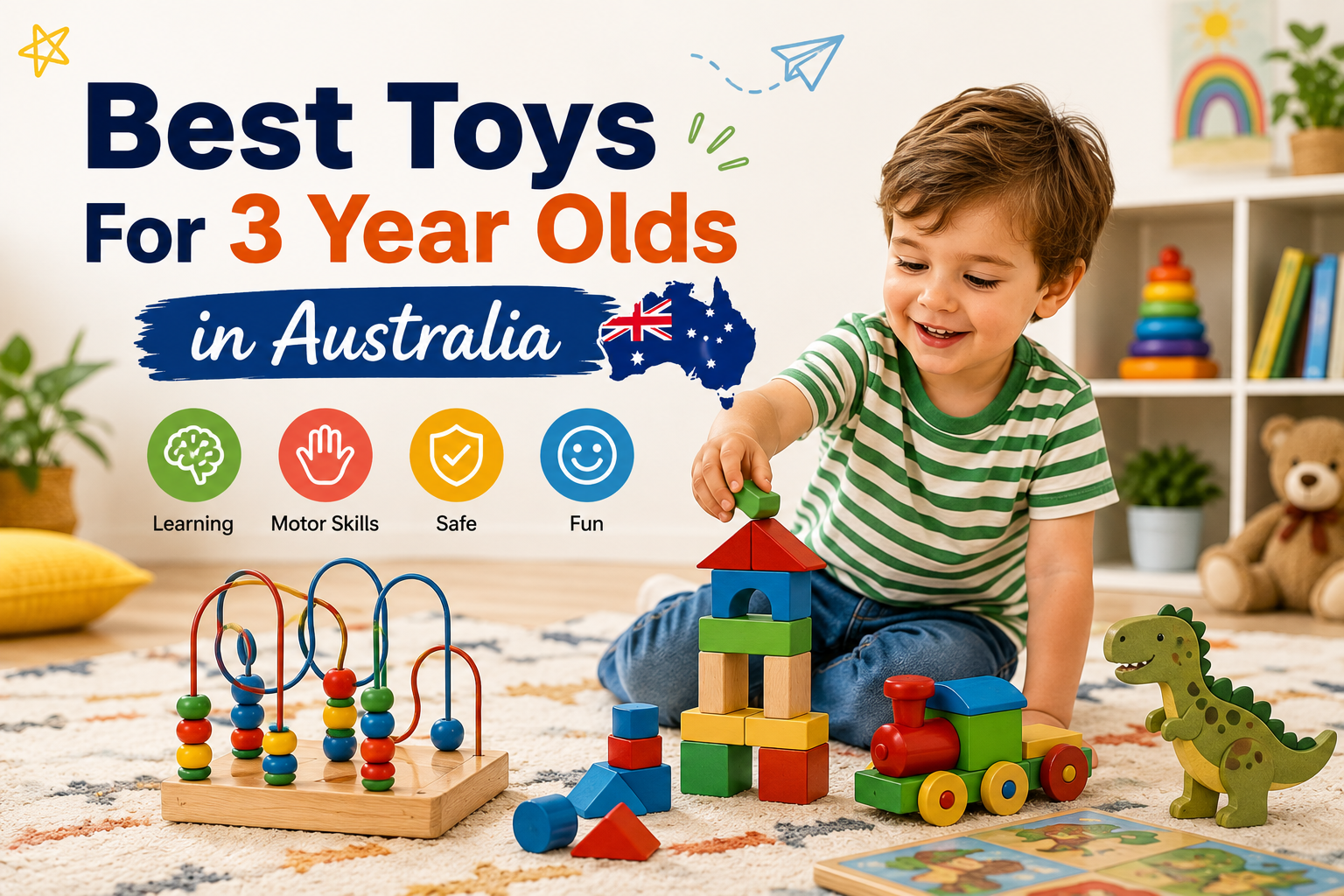
Quick answer: Three is when cooperative play, storytelling and rule-following arrive. The best toys for three year olds are dress-ups and role play sets, construction bricks, small-world figures, first board games, and outdoor gear like balance bikes and scooters. Budget $25–$180 per item in Australia. This is also the age when “3+” labelled toys with small parts finally become appropriate.
Key takeaways
- Three is the year sharing and rules start working Cooperative play arrives, which makes first board games genuinely viable for the first time.
- The “3+” label opens up now but only if there is no younger sibling in the house. That caveat matters more than most guides admit.
- Imagination is the main event. Dress-ups, small-world figures and role play sets get more use than anything electronic.
- Fine motor work becomes preschool preparation. Scissors, threading and drawing build the grip that writing depends on.
- Buy for the story, not the licence. A generic doctor’s kit gets played with as long as a branded one, at a third of the price.
Three is a genuinely enjoyable age to buy for. Your child can tell you what they want, sustain a made-up game for half an hour, and finally follow a simple rule. The toys that suit this stage are also more varied than at any earlier age, which makes choosing harder rather than easier.
This guide covers what changes at three, what to buy, and the one safety caveat that catches most Australian families out. It sits inside our wider baby toys by age guide.
What changes at three
Cooperative play arrives. Two year olds play alongside each other. Three year olds start playing with each other — assigning roles, agreeing on a scenario, taking turns. It is gradual and imperfect, but it is a real shift, and it changes what toys work in a group.
Storytelling becomes elaborate. Pretend play at two is single actions: feeding a doll, driving a car. At three it becomes narrative — the doll is sick, so it goes to hospital, and the car is the ambulance. Toys that support a story get far more use than toys that do one thing.
Fine motor control jumps. Most three year olds can thread beads, use child-safe scissors, and draw recognisable shapes. A proper tripod pencil grip usually develops through this year. This matters practically, because Australian preschool and kindy programs assume some of these skills.
Rules become possible. Not reliably, and not without protest, but a three year old can understand “we take turns” in a way a two year old cannot. First board games become viable here.
Physically, most three year olds run confidently, jump with both feet, pedal a trike, and many manage a balance bike or scooter well.
The “3+” label: what it actually means now
Worth understanding properly, because it is the biggest practical change at this birthday.
Age labels on toys are safety ratings, not development ratings. “3+” almost always means the toy contains small parts that are a choking hazard for under-threes. It rarely means the toy is too advanced for a younger child.
Once your child turns three, that restriction technically lifts. Lego, small figurines, craft beads and construction sets with small pieces all become options.
But there is a large caveat. If you have a younger sibling in the house, the small-parts rule still applies to your home, not your three year old. A two year old will find a stray Lego piece long before you do.
If you have a younger child:
- Keep small-part toys to a table or a room the younger one cannot access unsupervised
- Use a lidded container that only the older child can open, and pack away completely after each session
- Accept that “completely” is doing a lot of work in that sentence, and vacuum regularly
The choking test does not change anything that fits through a toilet roll tube remains a hazard for under-threes. Full method: choking hazards and the small parts test.
The best toys for 3 year olds
1. Dress-ups and role play sets
The highest play-value category at this age, and among the cheapest. Doctor’s kit, tool set, shop, vet, firefighter, chef. Anything that lets your child be someone.
Buy generic over branded. A plain doctor’s kit supports exactly the same play as a licensed character version, at roughly a third of the price. The story is coming from your child, not the packaging.
Op shops and marketplace listings are excellent for dress-up clothing specifically.
AU price: $20–$60.
2. Construction bricks
Graduate from large blocks to interlocking bricks. Duplo-size pieces suit three well; standard Lego suits from around four, though many three year olds manage it with supervision.
Buy a plain brick set rather than a themed model kit. Model kits are built once, displayed, and never touched again. Loose bricks get used for years.
AU price: $30–$120.
3. Small-world figures and playsets
Animal figures, people, vehicles, a doll’s house, a farm, a garage. These are the props that narrative play runs on.
You do not need a matched set. A mix of figures from different sources works just as well, and secondhand is genuinely fine here.
AU price: $20–$100.
4. Puzzles 12 to 30 pieces
Step up from chunky puzzles. Start around twelve pieces and increase when your child completes them without help.
Floor puzzles with large pieces are a good bridge, and easier for small hands than table jigsaws.
AU price: $15–$40.
5. Balance bikes and scooters
Most three year olds are ready for a balance bike, and many for a three-wheeled scooter. Both build the balance that pedal bikes later depend on a child who masters a balance bike often skips training wheels entirely.
Check seat height: both feet flat on the ground when seated. A helmet is required by law for bicycles on Australian roads and paths, and is sensible for scooters regardless.
AU price: $80–$180.
6. Craft supplies and first scissors
Child-safe scissors, glue stick, paper, chunky crayons, stickers, threading beads. This is preschool preparation disguised as an activity.
Cutting is a specific skill and harder than it looks expect a lot of confetti before anything resembles a shape.
AU price: $20–$50.
7. First board games
Now genuinely viable. See the next section.
AU price: $15–$40.
First board games that actually work at three
Most board games marketed at this age fail for the same three reasons: too long, too much reading, and too much losing.
What to look for:
| Feature | Why it matters |
| Under 15 minutes | Attention span is the binding constraint, not comprehension |
| No reading required | Colours, pictures and symbols only |
| Cooperative, not competitive | Everyone wins or loses together — avoids the meltdown |
| Simple turn structure | One action per turn. Roll and move, or match and place |
| Chunky pieces | Small hands, and small parts if there is a younger sibling |
Cooperative games where players work together against the board are far more successful at three than competitive ones. Losing is genuinely hard at this age, and a game that ends in tears every time will not get played twice.
Colour-matching games, simple memory games and basic first-to-the-end race games all work. Anything requiring strategy, counting past ten, or reading does not.
Preschool readiness: the fine motor toys that matter
Australian preschool and kindy programs generally expect some hand strength and control by four. These toys build it, and none of them look like schoolwork.
- Threading beads and lacing cards bilateral coordination, both hands working together
- Playdough with cutters and rollers hand strength, which pencil grip depends on
- Tongs, tweezers and scoops precision grip, and endlessly extendable with household items
- Child-safe scissors a genuinely difficult skill that takes months
- Chunky crayons and thick pencils tripod grip develops through this year
- Pegboards and simple sewing cards precision and patience
None of this needs to be bought as a set. A bag of pasta, a pair of kitchen tongs and two bowls is a legitimate fine motor activity, and many Australian preschools use exactly that.
What to skip at three
| Toy | Why |
| Themed model kits (build once) | Built, displayed, forgotten. Loose bricks last years |
| Competitive board games | Losing is very hard at three. Cooperative games work far better |
| Licensed character versions of generic toys | Same play, up to three times the price |
| Electronic learning tablets | Still passive, still poor value per year of use |
| Complex jigsaws (50+ pieces) | Frustration. Build up gradually from 12 |
| Anything with small parts, if you have a toddler at home | The rule applies to the house, not the child |
Safety at three
The risks change, but they do not disappear.
- Small parts, if there is a younger sibling. The single most common oversight at this age. Covered in full above.
- Helmets for wheeled toys. Legally required for bicycles on Australian roads and paths, and sensible for scooters and balance bikes.
- Magnets. Craft and construction sets sometimes include small high-powered magnets, which are dangerous if more than one is swallowed. Magnets in toys.
- Button batteries in light-up craft items, novelty toys and party favours. Compartments must be screw-secured.
- Craft supply safety. Check glue, paint and dough are non-toxic and age-labelled.
Full Australian standards breakdown and printable checklist: baby toy safety in Australia.
What it costs in Australia
| Item | Budget | Mid-range |
| Dress-ups / role play set | $20 | $60 |
| Construction bricks | $30 | $120 |
| Small-world figures | $20 | $100 |
| Puzzles (2) | $30 | $70 |
| Balance bike or scooter | $80 | $180 |
| Craft supplies | $20 | $50 |
| First board game | $15 | $40 |
| Total | $215 | $620 |
Three is the age where secondhand becomes genuinely excellent value. Dress-ups, construction bricks, small-world figures and balance bikes all appear constantly on Australian marketplace listings, and none of them wear out in a way that matters.
Prices are indicative for 2026 and vary by retailer and sale period.
What comes next
At four, construction gets more ambitious, games get more competitive, and interests narrow sharply. Our age-by-age guides continue in best toys for 4 year old boys, and for a view across the whole age range without the gendered framing, see our guides to toys for girls and boys.
Frequently asked questions
What are the best toys for a 3 year old? Dress-ups and role play sets, construction bricks, small-world figures, and a balance bike or scooter. Three is when imaginative storytelling takes over, so toys that support a narrative get the most use.
Can a 3 year old play board games? Yes, with the right ones. Look for games under fifteen minutes, with no reading, chunky pieces, and ideally a cooperative structure where players work together rather than compete. Losing is genuinely difficult at this age.
Is Lego safe for a 3 year old? Standard Lego is labelled 3+, so it is appropriate once your child turns three — unless there is a younger sibling in the house. The small-parts rule applies to everyone in the home, not just the child playing.
What does the “3+” label on toys mean? It is a safety rating, not a difficulty rating. It almost always means the toy contains small parts that pose a choking risk to children under three, rather than that the toy is too advanced for them.
When can a child use a balance bike? Most children manage one from around two and a half to three, once they can walk and run confidently. Both feet should sit flat on the ground when seated.
What toys help prepare a 3 year old for preschool? Threading beads, playdough, child-safe scissors, tongs and chunky crayons. All build the hand strength and precision grip that writing depends on later. Household items work as well as bought sets.
How we choose the toys we recommend
Every recommendation is assessed against Australian safety standards, developmental fit for the stated age, durability under real use, washability, and value at current Australian retail prices. We prioritise products actually available to buy in Australia. Affiliate links, where used, are disclosed at the top of the article and do not affect ranking.
Sources referenced: Product Safety Australia (ACCC) for mandatory toy standards, age labelling and small parts rules; Kidsafe Australia for helmet and wheeled toy guidance; Raising Children Network for developmental milestone ranges.