Are Second Hand Baby Toys Safe? What Parents Should Know
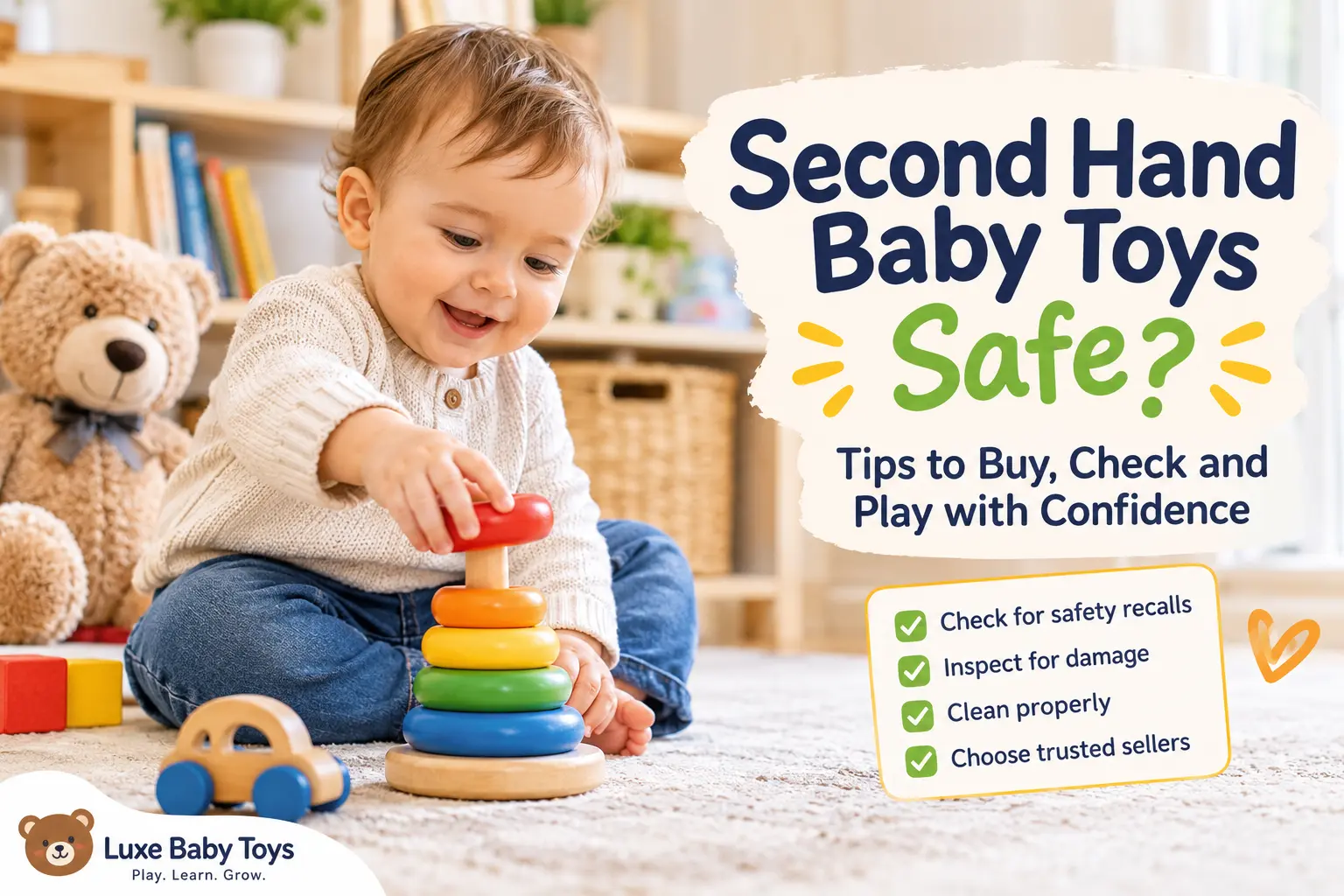
Second-hand baby toys can be safe if they are age-appropriate, in good condition, free from dangerous parts and checked for product recalls. However, second hand baby toys safe is not a question parents can answer by looking at a toy’s appearance alone. Older toys may have hidden damage, missing safety information or components that create choking, poisoning or injury risks.
For Australian families, buying pre-loved toys or accepting hand-me-down baby toys can be a practical way to reduce spending and reuse useful products. The safest approach is to inspect every toy before bringing it into your baby’s play area, clean it according to the manufacturer’s instructions and reject anything that fails a safety check.
This guide explains how to choose used baby toys, identify warning signs, clean different materials and make informed buying decisions.
Key Takeaways
- Second hand baby toys can be suitable for use when their condition, age suitability and safety have been carefully checked.
- Australian parents should check the official product recall database before buying used toys.
- Broken plastic, loose components, accessible button batteries and small detachable magnets are reasons to reject a toy.
- Cleaning removes dirt and may reduce germs, but it cannot repair structural damage or make a recalled toy safe.
- Hand-me-down baby toys require the same safety inspection as toys purchased from a second-hand shop.
- Parents should follow the manufacturer’s cleaning instructions and supervise babies during play.
Are Second-Hand Baby Toys Safe for Babies?
Yes, second-hand baby toys can be safe when they remain structurally sound, suit the baby’s age and meet applicable safety requirements. However, parents should never assume that a toy is safe simply because another child used it without an obvious problem.
The Australian Competition and Consumer Commission (ACCC) recommends checking second-hand toys for recalls, compliance with mandatory standards, instructions for safe use and properly functioning parts. These checks are particularly important for babies under three because they frequently explore toys by putting them in their mouths.
What makes a pre-loved baby toy safe?
A suitable second-hand toy should meet these basic conditions:
- It has no cracks, sharp edges or broken sections.
- It contains no loose pieces that could become choking hazards.
- Its battery compartment, if present, is secure.
- Its materials are intact, with no peeling paint, mould or excessive deterioration.
- Its age recommendation suits your baby.
- Its manufacturer instructions and important safety information are available where needed.
- It has not been recalled and is not subject to a relevant safety prohibition.
Additionally, parents should consider how the baby will use the toy. A product designed for an older child may contain small components that become dangerous when a younger baby handles or chews them.
The rule is simple: If you cannot establish that a second-hand toy is suitable and safe, do not give it to your baby.
Why Do Australian Parents Buy Second-Hand Baby Toys?
Buying second-hand toys can reduce household spending and extend the useful life of products that remain in good condition. Nevertheless, the lower price should never outweigh the need for a careful safety inspection.
Babies often outgrow particular toys or lose interest in them as their abilities change. Consequently, a toy that another family no longer needs may still offer useful play opportunities for your child.
What are the benefits of buying pre-loved toys?
Lower purchase costs: Second-hand toys may cost less than comparable new products. This can help families manage expenses, especially when they need several age-appropriate play options.
Reuse of usable products: Passing toys between families can extend their useful life instead of sending them straight to waste.
Access to familiar toys: Hand-me-downs from relatives may already have known histories, making it easier to ask about their age, cleaning routine and previous damage.
More flexible toy choices: Parents can look for suitable toys without feeling that every item must be purchased brand-new.
However, these benefits depend on the toy’s actual condition. A cheap toy that needs repairs, has missing parts or cannot be cleaned properly may not be a sensible purchase.
For more ideas on choosing useful playthings without overspending, read Luxe Baby Toys’ guide to how many toys a baby needs. A smaller, carefully selected collection can be easier to maintain and inspect.
What Should You Check Before Buying Second-Hand Baby Toys?
Before buying a used baby toy, inspect its condition, age label, construction, small parts, battery compartment and recall status. If possible, examine the actual product rather than relying on the seller’s photographs.
A toy may look clean in a listing but still have cracks, worn connections or missing safety information. Therefore, complete your checks before paying or allowing your baby to use it.
1. Inspect the overall condition
Look closely at every side of the toy. Check for cracks, sharp edges, exposed screws, broken sections and signs of deterioration.
Plastic can become brittle over time. Fabric can tear, and wooden toys can develop splinters. Reject any item that could break apart during normal handling.
2. Check for loose or detachable parts
Examine buttons, eyes, noses, wheels, decorative pieces and other attached components. Gently inspect the construction without deliberately damaging the toy.
If a component is loose or could detach during ordinary use, do not give the toy to a baby. This is especially important for children under three, who face particular risks from small parts.
3. Look for age recommendations
Check the manufacturer’s label or instructions to establish the intended age range. A toy suitable for a preschooler may not be appropriate for an infant.
If the label is missing, investigate the exact product model before purchasing it. Do not guess its age suitability based only on its size or appearance.
4. Inspect battery compartments
Avoid toys with damaged or insecure battery compartments. Light-up, musical and moving toys deserve particular attention because they may contain button batteries.
5. Check the product’s history
Ask the seller how old the toy is, whether any components have been replaced and whether the product has experienced damage. Request the original instructions or model information when available.
Finally, search for the product in Australia’s official recall database. If the seller cannot identify the product and you cannot establish its safety, choose another toy.
Which Second-Hand Baby Toys Are Safer to Consider?
Simple toys with intact construction, clear age recommendations and easy-to-clean surfaces are often easier to assess than complicated products with batteries, moving components or many detachable parts. However, no toy category is automatically safe just because it has been used before.
The following table can help you decide which items deserve consideration.
| Toy type | What to inspect | Buying advice |
|---|---|---|
| Sturdy plastic stacking cups | Cracks, sharp edges and broken sections | Consider if the material remains intact and the toy suits the baby’s age |
| Solid wooden blocks | Splinters, loose pieces and peeling paint | Consider only if smooth, intact and appropriately finished |
| Board books | Loose pages, torn coverings and damaged edges | Consider if clean, sturdy and suitable for the intended age |
| Fabric activity books | Loose stitching, damaged fabric and detachable pieces | Check carefully and confirm that the toy can be cleaned properly |
| Soft toys | Seams, eyes, noses, filling and odours | Accept only if securely constructed and thoroughly cleanable |
| Plastic rattles | Cracks, loose parts and sound-producing components | Check construction carefully because babies may chew them |
| Battery-operated toys | Battery compartment, wiring, damage and recalls | Apply extra caution; reject insecure battery compartments |
| Bath toys | Water trapped inside, mould and deterioration | Avoid toys with inaccessible interiors that cannot be cleaned and dried properly |
| Teethers | Cracks, tears, surface deterioration and material information | Prefer a new, suitable teether when its previous condition or hygiene is uncertain |
Remember that these are inspection guidelines, not a guarantee that any particular toy is safe. A damaged product should be rejected regardless of its original price or brand.
Which Second-Hand Baby Toys Should You Avoid?
Parents should reject used toys with broken components, loose small parts, accessible button batteries, dangerous magnets, peeling paint or damage that prevents proper cleaning. They should also avoid products that have been recalled or cannot be identified well enough to establish their safety.
A toy does not become suitable for a baby simply because it has been washed or repaired.
Toys with small detachable parts
Loose buttons, beads, plastic pieces and decorative components can cause choking or other serious injuries. Soft toys require special attention because their eyes, noses, stitching and filling can become loose.
If you notice loose threads, exposed stuffing or damaged seams, keep the toy away from your baby.
Toys containing button batteries
Button batteries can cause severe internal injuries if swallowed. Do not purchase a battery-operated toy with a damaged compartment, missing cover or uncertain battery security.
The ACCC provides specific guidance on button battery safety, including precautions for second-hand products.
Toys containing small or high-powered magnets
Magnets can cause serious internal injuries if swallowed. Avoid used toys with missing magnetic pieces, damaged housings or uncertain magnet security.
Do not attempt to repair a toy with missing magnets and return it to a baby’s toy collection.
Old toys with peeling paint
Older toys may contain paint or other materials that present hazards. Peeling or flaking paint is a clear reason to reject a toy, particularly when the material and product history are unknown.
Foam toys and deteriorating materials
Some foam toys can break into pieces when babies bite or chew them. Avoid products that are crumbling, damaged or unsuitable for the child’s age.
Also reject toys with mould, persistent musty odours, inaccessible dirty interiors or surfaces that cannot be cleaned as directed.
How Can You Check Whether a Second-Hand Toy Has Been Recalled in Australia?
You can check whether a used toy has been recalled by searching Australia’s official Product Safety website. Use the product name, manufacturer, model number or identifying details to find relevant recall notices.
A recall check should happen before purchase whenever possible. If you discover a relevant recall after buying a toy, stop using it and follow the recall notice’s instructions.
Follow these steps
- Identify the product. Find the brand, model number, manufacturer and any identifying labels.
- Visit Product Safety Australia. Open the official product recalls database.
- Search the product details. Try the brand and model name. If the product has no visible model number, use the available identifying information.
- Read matching notices carefully. Check whether the recall applies to the same product and model.
- Follow the official instructions. Do not give a recalled product to a child while you investigate what to do next.
If the toy is too old or poorly labelled to identify, a lack of an obvious search result does not prove that it is safe. In that situation, consider whether you can establish its origin and suitability through reliable product information.
The ACCC also explains the requirements for toys intended for children up to and including 36 months. These requirements address risks such as small parts becoming detached during use.
How Do You Clean Second-Hand Baby Toys Before Use?
Clean second-hand baby toys according to their material and the manufacturer’s care instructions. First remove visible dirt, then use an appropriate cleaning method and allow the toy to dry completely before returning it to your baby’s play area.
Cleaning is essential, but it does not replace a safety inspection. A toy with a loose part, cracked surface or insecure battery compartment should be rejected even if it looks spotless.
How to clean different toy materials
Plastic toys: Wash suitable solid plastic toys with warm water and mild detergent when the manufacturer permits it. Clean grooves and joints carefully, rinse as directed and dry thoroughly.
Wooden toys: Follow the manufacturer’s instructions for cleaning finished wood. Avoid soaking wooden toys unless the manufacturer specifically allows it, as moisture can damage the material.
Fabric toys: Check the care label before washing. Use the permitted washing method and make sure the filling and seams dry completely.
Board books: Clean the surface according to the publisher’s or manufacturer’s guidance. Avoid soaking books that can absorb water, warp or develop mould.
Electronic toys: Follow the manufacturer’s instructions. Do not immerse an electronic toy in water unless it is specifically designed for that method.
Should you disinfect every second-hand toy?
Not necessarily. The appropriate approach depends on the toy’s material, condition, previous use and cleaning instructions. Use a disinfectant only when it is suitable for the product and follow its label directions.
Never mix cleaning chemicals. Keep cleaning products and disinfectants away from babies, and allow surfaces to dry as directed before use.
If a toy has mould inside an inaccessible compartment or cannot be cleaned adequately, discard it rather than trying to conceal the problem with fragrance or surface cleaning.
Are Hand-Me-Down Baby Toys Safe?
Hand-me-down baby toys can be safe, but they need the same checks as second-hand toys purchased from a shop or online marketplace. Knowing the previous owner can help you ask questions, but familiarity does not guarantee that the toy remains in good condition.
Before accepting a toy from a relative or friend, ask how long they have owned it, whether it has been damaged and whether its original instructions are available.
What should you ask the previous owner?
Use these questions to understand the toy’s history:
- How old is the toy?
- Has it ever cracked, broken or been repaired?
- Are all the original components present?
- Does it contain batteries or magnets?
- Are the original instructions or age labels available?
- Has it been exposed to mould, smoke or other contamination?
- Has the manufacturer or seller issued a recall notice?
You do not need to reject every older toy. However, if the previous owner cannot answer important questions and the toy’s safety cannot be established, choose a more suitable alternative.
Should you accept hand-me-down teethers?
Be particularly careful with teethers because babies commonly chew them. Reject teethers with cracks, tears, sticky or deteriorating surfaces, exposed filling or uncertain construction.
A new teether designed for your baby’s age may be a more sensible choice when you cannot verify the history, condition or cleaning requirements of a used one.
What Should You Check When Buying Used Baby Toys Online?
When buying used baby toys online, ask for clear photographs, product identification and information about damage, missing parts and cleaning. If possible, inspect the item in person before paying.
Online listings can hide wear that would be easy to spot during a physical inspection. A seller’s description is useful, but it cannot replace checking the actual product.
Ask the seller for these details
- The manufacturer’s name and product model.
- The recommended age range.
- Clear photographs of the toy from several angles.
- Close-up images of labels, battery compartments and worn areas.
- Information about missing, replaced or repaired parts.
- The original instructions, if available.
- Confirmation of whether the seller knows of any recall or safety issue.
Be cautious if a seller refuses to show damaged areas, cannot identify the product or claims that an unsafe feature does not matter because the toy is old.
Additionally, do not rely on phrases such as “barely used”, “like new” or “perfect for newborns” as proof of safety. Assess the product itself.
How Can You Tell If a Used Baby Toy Is Too Old?
A toy may be too old to use safely if its materials have deteriorated, its parts are missing, its safety information is unavailable or you cannot establish that it is suitable for your baby. Age alone does not determine safety, but older products deserve careful inspection.
For example, an intact wooden block may remain usable for years if its construction and materials are suitable. In contrast, a plastic toy that has become brittle may break even if it looks relatively clean.
Warning signs to look for
- Plastic that cracks, flakes or breaks easily.
- Rubber or silicone that has become damaged or deteriorated.
- Peeling paint or an unknown surface coating.
- Loose screws, joints or attached components.
- Frayed fabric, broken seams or exposed stuffing.
- Corrosion or damage around battery compartments.
- Missing manufacturer details or safety instructions.
- A product that appears to have been modified or repaired in an unsafe way.
If a toy fails an inspection, do not pass it to another family without explaining the problem. Remove unsafe items from circulation and dispose of them appropriately.
How Can Parents Choose Safe Toys Without Buying Everything New?
Parents can combine suitable pre-loved toys with carefully chosen new products. The goal is to build a small collection that matches the baby’s current abilities while ensuring every item is safe and practical to maintain.
Start by identifying the types of play your baby enjoys. For example, your child may benefit from simple grasping toys, sturdy books and supervised opportunities to explore movement.
Next, assess the toys you already have. Keep items that remain appropriate and intact, and remove anything damaged or unsuitable.
Finally, buy additional toys only when they offer something useful that your existing collection does not provide.
Luxe Baby Toys’ guide to educational toys for one-year-olds provides further ideas for choosing age-appropriate playthings. You can also explore baby play ideas at home for activities that combine movement, interaction and exploration without requiring a large collection of products.
Remember that a toy’s educational value does not override its safety. A simple, intact toy that suits your baby’s age is a better choice than a complicated product with questionable construction.
What Are the Advantages and Disadvantages of Second-Hand Baby Toys?
Second-hand baby toys offer potential savings and reuse benefits, but they can also come with hidden wear, missing safety information and uncertain product histories. Parents should weigh these factors before making a purchase.
Advantages
- Lower cost: Pre-loved toys may be more affordable than new alternatives.
- Product reuse: Suitable toys can remain useful to another family.
- Known history: Hand-me-downs from trusted relatives may come with helpful information about previous use.
- More flexible choices: Parents can build a varied collection without buying every item new.
Disadvantages
- Hidden damage: Cracks and weakened components may not be obvious in photographs.
- Missing instructions: Older toys may lack important age or maintenance information.
- Recall concerns: A used toy may be subject to a recall that the seller does not know about.
- Cleaning difficulties: Some toys have inaccessible areas that cannot be cleaned or dried properly.
- Uncertain materials: Older toys may have unknown finishes, coatings or replacement components.
Ultimately, the right decision depends on the individual toy. A suitable second-hand product can be a practical option, while a damaged or poorly identified toy should be rejected regardless of its price.
Frequently Asked Questions About Second-Hand Baby Toys
Are second-hand baby toys safe for newborns?
Second-hand toys can be suitable for newborns if they are specifically designed for that age, remain intact and have no dangerous small parts or other hazards. Check the manufacturer’s age guidance, clean the toy appropriately and supervise its use. Keep all toys out of the newborn’s sleep space.
Should I buy new toys instead of second-hand toys?
Not necessarily. Some second-hand toys may be suitable after careful inspection, but new toys can be preferable when the condition, cleaning history or product identity of a used item is uncertain. Choose based on verified safety, not price alone.
Can I give my baby toys from an older sibling?
Yes, if each toy remains suitable for your baby’s age and passes a fresh inspection. Check for missing components, cracks, loose stitching, accessible batteries and recalls. A toy that was suitable for an older child may still be inappropriate for a younger baby.
How do I know if a second-hand toy is clean enough?
Follow the manufacturer’s cleaning instructions and inspect the toy for visible dirt, mould, unusual odours and damage. Make sure it dries completely before use. If you cannot clean an item properly or suspect contamination inside an inaccessible area, do not give it to your baby.
Are second-hand wooden toys safe?
Wooden toys can be suitable if they are structurally sound, smooth and made with appropriate materials and finishes. Reject items with splinters, loose components, peeling paint or damage that could cause injury. Check age suitability and product identification where possible.
Are used teethers safe for babies?
Used teethers require particular care because babies chew them directly. Avoid products with cracks, tears, deterioration or uncertain cleaning histories. If you cannot establish that a used teether is safe and cleanable, choose a new teether designed for your baby’s age.
What should I do if a second-hand toy has been recalled?
Stop using the toy and keep it away from children. Find the relevant recall notice on the official Product Safety Australia website and follow its instructions. Do not give the recalled item to another family or sell it again.
How often should I inspect second-hand toys after buying them?
Inspect toys before their first use and continue checking them regularly during normal play. Remove any item immediately if it cracks, tears, develops loose parts or shows other signs of deterioration. Regular checks help identify new damage that may develop after purchase.
Final Verdict: Are Second-Hand Baby Toys Safe?
Second-hand baby toys can be a sensible choice for Australian families, provided parents inspect every item carefully before use. Check the toy’s condition, age recommendations, small parts, battery compartments and recall history. Then clean it according to the manufacturer’s instructions.
The same principles apply to hand-me-down baby toys, online purchases and products found at second-hand shops. A familiar seller or attractive price does not replace a safety check.
If you cannot establish that a toy is suitable, cleanable and in good condition, do not give it to your baby. Choose a safer alternative and remember that babies can enjoy simple, age-appropriate play without a large collection of toys.
A careful inspection before play is one of the most useful steps parents can take to make pre-loved toys a safer choice.