Best Toys for 6–12 Month Babies (Australian Guide)
Quick answer: Between six and twelve months babies learn cause and effect, object permanence and the pincer grasp, while moving from sitting to crawling to pulling up. The best toys for this stage are stacking cups, ball drop toys, board books with flaps, simple pop-up toys and a stable push-along walker. Budget $80-$200 in Australia for a full set.
Key takeaways
- This is the cause-and-effect stage, and it is the one where the right toy makes the most visible difference in the whole first year.
- Stacking cups are the best value baby toy there is. Around $10, and they stay in use for two years.
- The pincer grasp arrives around nine months and makes your home significantly more dangerous overnight.
- Choose a push walker, not a sit-in walker. Australian safety bodies including Kidsafe advise against the wheeled sit-in type because of fall injuries.
- Object permanence turns peek-a-boo into a genuine cognitive game rather than just a laugh.
If the first six months were about your baby working out that they have hands, the second six are about working out that they can change things. Press a button, a thing happens. Drop a cup, it lands. Hide a toy under a cloth, it is still there.
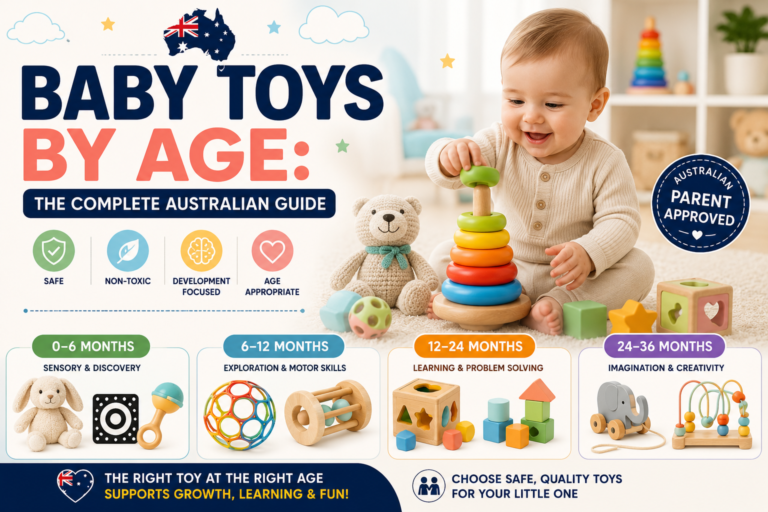
That shift, from observing to experimenting, is the biggest cognitive change of the first year, and it should drive everything you buy. This guide covers the toys that support it, split into the two distinct halves of this window. It sits inside our wider baby toys by age guide.
What develops between six and twelve months
Four shifts happen here, and each one unlocks a category of play.
Cause and effect. Around seven to eight months, most babies work out that their actions produce results. This is why ball drops, pop-ups and anything with a lid become suddenly fascinating. Crucially, your baby wants to be the one causing the effect, a toy that performs by itself holds far less interest than one that responds to them.
Deliberate release. Your baby could grab from four months, but letting go on purpose is a separate skill that arrives around eight months. It is what makes stacking, posting and dropping games possible. It is also why they will now drop food from the highchair forty times in a row and watch it land every time. That is physics research, not defiance.
Object permanence. The understanding that hidden things still exist develops through this window. It turns peek-a-boo from a startle game into a real cognitive one, and it is why flap books work so well.
The pincer grasp. Around nine to ten months, thumb and forefinger start working together. It is a genuine milestone, and the moment your floor becomes a hazard, because your baby can now pick up anything small enough to choke on.
Physically, most babies sit unsupported around six to eight months, crawl somewhere between seven and ten, pull to stand around nine, and cruise along furniture by ten to twelve. The ranges are wide and normal.
Best toys for a 6-9 month old (the sitting stage)
Once your baby can sit, both hands are free for the first time. Play gets dramatically more capable.
Stacking cups
The single best value toy of the first year, and it is not close. Around $10 for a set.
They nest, stack, hide things underneath, get chewed, go in the bath, get thrown, and survive all of it. More importantly they grow with your baby: at seven months they are for banging and mouthing, at ten months for nesting, at eighteen months for stacking towers, and at two for pouring water and sand.
If you buy one thing from this guide, buy these.
AU price: $6-$20. Kmart, Big W and Target all carry them.
Ball drop and post toys
The purest form of cause and effect: put the ball in the top, watch it come out the bottom. Endlessly repeatable, which is exactly what a baby at this stage wants.
Choose one with balls too large to swallow, check them against the toilet roll test before the toy reaches your baby.
AU price: $20-$45.
Board books with flaps
Object permanence in book form. Lift the flap, the thing is still there. Sturdy board pages survive mouthing, and shared reading at this age does more for later language than almost anything else you can do.
AU price: $10-$20.
Simple musical and percussion toys
Drums, shakers, anything struck. Your baby makes the sound, which matters, passive electronic music does far less.
AU price: $10–$30.
Bath cups and pourers
Bath time becomes genuine play once your baby can sit steadily. Pouring, filling and tipping is fine motor practice with the mess contained.
AU price: $8-$25.
Best toys for a 9-12 month old (crawling and pulling up)
Mobility changes what your baby wants. Toys that move, or that reward moving towards them, come into their own.
Rolling and chase toys
A ball or wheeled toy that rolls away is powerful motivation for a new crawler. Simple, cheap, effective.
AU price: $8-$25.
Push-along walker wagons
The right choice for a baby pulling to stand and starting to cruise. Look for two things: a weighted or wide base so it does not shoot away and cause a fall, and adjustable wheel resistance if available.
A wagon that doubles as a toy carrier is a genuine bonus, babies at this age love transporting things from one room to another for no discernible reason.
AU price: $50–$150.
A safety note worth reading properly. There are two very different products both commonly called “baby walkers”:
| Type | What it is | Verdict |
| Push walker / walker wagon | Baby stands behind and pushes, feet on the floor | Fine, and useful, choose a stable, weighted one |
| Sit-in baby walker | Wheeled frame with a fabric seat the baby sits inside | Avoid. Australian safety organisations including Kidsafe advise against them due to fall and burn injury risk, particularly near steps and hot surfaces |
Sit-in walkers are still legally sold in Australia under a mandatory safety standard, but legal availability is not a safety endorsement. If you are choosing between the two, choose the push type.
Pop-up and lever toys
Press, slide, flip, a thing appears. Combines cause and effect with object permanence, and the physical actions build finger strength ahead of the pincer grasp.
AU price: $20–$40.
Nesting and posting boxes
Simple shape posting with two or three shapes maximum. Ten-shape sorters are for well after the first birthday, starting there produces frustration, not learning.
AU price: $20–$45.
Soft blocks
Large, lightweight, safe to fall on. Stacking two blocks is typically a first-birthday skill, but knocking over a tower you built is a nine-month-old’s favourite thing in the world.
AU price: $20–$50.
What to skip
| Item | Why not yet | When it fits |
| Ten-shape sorters | Difficulty should ramp, not start at the top | 15–18 months |
| Ride-on toys | Not steady enough to sit and push with feet | 12–18 months |
| Small figurines, toy cars with small wheels | Choking hazard once the pincer grasp arrives | 3 years+ |
| Craft supplies, crayons | Everything still goes in the mouth | 18 months+ |
| Balance bikes | Years early | 2.5 years+ |
| Battery toys that perform by themselves | Your baby wants to cause the effect, not watch it | — |
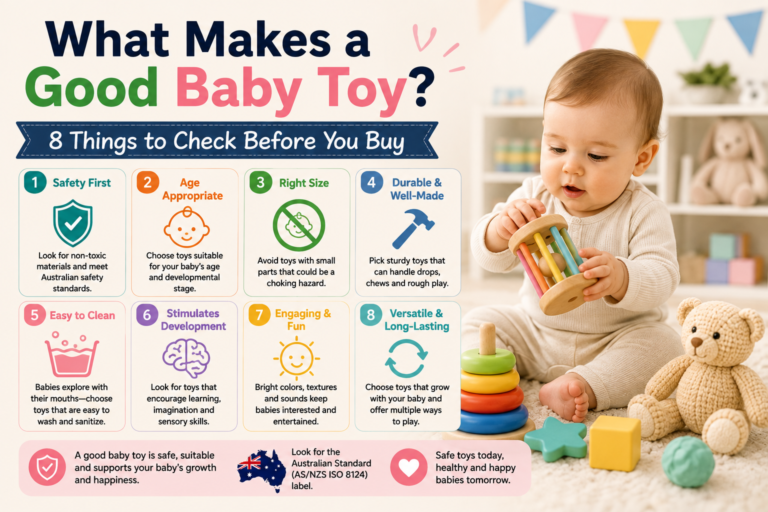
If you would rather assess toys yourself than follow age lists, what makes a good baby toy sets out the eight checks worth running on any purchase.
Safety: the pincer grasp changes everything
Up to about nine months, your baby could only grab whole-handed, which ruled out most small objects. Once thumb and forefinger work together, that protection disappears.
What to do about it:
- Get on the floor at your baby’s eye level and look. You will find things you did not know were there.
- Run the toilet roll test on everything within reach. If it fits through the tube, it is a choking risk for under-threes. Full method: choking hazards and the small parts test.
- Check battery compartments. This is the stage where battery-powered toys enter the house in volume. Compartments must be screw-secured. Button batteries in particular can cause serious internal injury if swallowed, see button batteries in toys.
- Inspect older toys weekly for cracks and loosening parts. Chewing degrades plastic and adhesive.
- Anchor furniture before your baby starts pulling to stand. Not a toy issue exactly, but it becomes urgent in exactly this window.
The full Australian standards breakdown and a printable checklist are in baby toy safety in Australia.
What it costs in Australia
| Item | Budget | Mid-range |
| Stacking cups | $6 | $20 |
| Ball drop toy | $20 | $45 |
| Flap board books (2) | $20 | $40 |
| Push walker wagon | $50 | $150 |
| Pop-up or lever toy | $20 | $40 |
| Soft blocks | $20 | $50 |
| Total | $136 | $345 |
The walker wagon is the one item genuinely worth waiting for a sale on, or buying secondhand, they are bulky, expensive new, and used for a relatively short window.
Prices are indicative for 2026 and vary by retailer and sale period.
Buying for a first birthday
A large share of parents reading this are also fielding “what should we get them?” questions from relatives. The honest answer for a twelve-month-old is usually: fewer, larger, longer-lasting things.
Our shortlist of gifts that survive past week one is in first birthday gift ideas: 25 toys that get played with, and the stage immediately ahead is covered in best toys for 1 year olds in Australia.
Frequently asked questions
What toys are best for a 6 month old? Stacking cups, ball drop toys, board books and bath cups. Six months is around when most babies sit unsupported, which frees both hands and makes two-handed play possible for the first time.
What toys help a baby learn to crawl? Anything that rolls or moves just out of reach. A ball placed slightly beyond a baby’s grasp is more effective motivation than any product marketed specifically for crawling.
Are baby walkers safe in Australia? Push-along walker wagons are fine and useful. Sit-in wheeled walkers are a different product, and Australian safety organisations including Kidsafe advise against them because of fall and burn injury risk. They remain legally sold under a mandatory standard, but that is not a safety endorsement.
What toys are good for a 9 month old? Push walkers, rolling toys, pop-up toys and simple two-shape posting boxes. Nine months is roughly when the pincer grasp develops and most babies pull to stand.
How many toys does a 6–12 month old need? Six to eight accessible at a time, rotated every two to three weeks. Fewer toys in view reliably produces longer and more focused play.
When do babies understand peek-a-boo? Object permanence develops gradually across this window, generally becoming solid somewhere between eight and twelve months. That is when peek-a-boo shifts from a startle response to a genuine game.
How we choose the toys we recommend
Every recommendation is assessed against Australian safety standards, developmental fit for the stated age, durability under real use, washability, and value at current Australian retail prices. We prioritise products actually available to buy in Australia. Affiliate links, where used, are disclosed at the top of the article and do not affect ranking.